“He's like fire and ice and rage. He's like the night, and the storm in the heart of the sun. He's ancient and forever. He burns at the center of time and he can see the turn of the universe. And... he's wonderful. - Tim Latimer”
―
Paul Cornell
“John Smith: Mankind doesn't need warfare and bloodshed to prove itself. Everyday life can provide honour and valour. Let's hope that from now on this country can find its heroes in smaller places. In the most ordinary of deeds.” ― Paul Cornell
“Rumpty!" he muttered, which was very rude if you were one of the few people in the universe who understood what it meant.” ― Paul Cornell, Doctor Who: Scream of the Shalka
“The brilliant escape, the funny line to cap it, despite the lack of timing. And the girl was still dead. The last act had not materialised. The world, and himself, remained so far from what they should be: so imperfect.” ― Paul Cornell, Doctor Who: Scream of the Shalka
“John: I'm experiencing an odd sensation. I think it might be patriotism.Spitfire: Steady. Too much of that can damage your health.” ― Paul Cornell, Captain Britain and MI13, Vol. 1: Secret Invasion
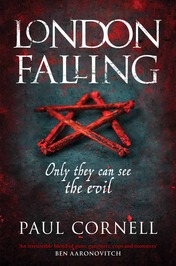
“You hear stories like that all your life and think: cool, a ghost bus. But now we have to look at this stuff analytically... a ghost bus?! The “ghost” of a motor vehicle? A public conveyance, presumably, which didn't head towards the light, move on to join the choir invisible in... bus heaven, the great terminus in the sky, where all good buses go when they... I don't know, break down, but instead is doomed to … drive eternally the streets of Earth! How can there be a ghost bus?!” ― Paul Cornell, London Falling
“He'd actually done it! He leaned back into the microphone and whispered to the now silent cave: 'Come to the Cabaret!” ― Paul Cornell, Doctor Who: Scream of the Shalka
“Wisdom: "Oh, fantastic. We've got an army made up of fairies and Beatles, and we're fighting H. G. Wells' martians and bloody Jack the Rippers. Who's next? Dick Van Dyke? Mr Bean? John Cleese and his dead parrot?” ― Paul Cornell, X-Men: Wisdom - Rudiments of Wisdom
“(The Skrull Beatles discuss their future.)"So when this is all over, are we still gonna be the Skrull Beatles then?""I quite fancy being the Skrull Monkees for a bit.""The dialogue's easier.""As long as I get to be Peter Tork.” ― Paul Cornell, X-Men: Wisdom - Rudiments of Wisdom
“When Captain America died, Americans heard it in an American way: through the media. When Captain Britain died, the British felt it in their chests.” ― Paul Cornell, Captain Britain and MI13, Vol. 1: Secret Invasion
“He began as a minor imitator of Fitzgerald, wrote a novel in the late twenties which won a prize, became dissatisfied with his work, stopped writing for a period of years. When he came back it was to BLACK MASK and the other detective magazines with a curious and terrible fiction which had never been seen before in the genre markets; Hart Crane and certainly Hemingway were writing of people on the edge of their emotions and their possibility but the genre mystery markets were filled with characters whose pain was circumstantial, whose resolution was through action; Woolrich's gallery was of those so damaged that their lives could only be seen as vast anticlimax to central and terrible events which had occurred long before the incidents of the story. Hammett and his great disciple, Chandler, had verged toward this more than a little, there is no minimizing the depth of their contribution to the mystery and to literature but Hammett and Chandler were still working within the devices of their category: detectives confronted problems and solved (or more commonly failed to solve) them, evil was generalized but had at least specific manifestations: Woolrich went far out on the edge. His characters killed, were killed, witnessed murder, attempted to solve it but the events were peripheral to the central circumstances. What I am trying to say, perhaps, is that Hammett and Chandler wrote of death but the novels and short stories of Woolrich *were* death. In all of its delicacy and grace, its fragile beauty as well as its finality.Most of his plots made no objective sense. Woolrich was writing at the cutting edge of his time. Twenty years later his vision would attract a Truffaut whose own influences had been the philosophy of Sartre, the French nouvelle vague, the central conception that nothing really mattered. At all. But the suffering. Ah, that mattered; that mattered quite a bit.” ― Barry N. Malzberg, The Fantastic Stories of Cornell Woolrich
“The neighbors... hadn't, thankfully, done the usual by saying that Losley was a pleasant neighbor who'd kept herself to herself. (Always delivered in a tone of voice that suggested that, since keeping oneself to oneself was the single greatest thing one English person could do for another, the suspect ought to be excused whatever psychopathic shit they'd visited on other people.)” ― Paul Cornell, London Falling
“The telemarketers who called her up now seemed either desperate or resigned to the point of a mindless drone, until Judith, who had time on her hands and ice in her heart, engaged them in dark conversations that always got her removed from their lists.” ― Paul Cornell, Witches of Lychford
“Stories are about endings,’ he’d said. ‘They don’t mean anything unless they come to an end.” ― Paul Cornell, Doctor Who: The Shadows of Avalon
“Dr. Louis Jolyon “Jolly” West was born in New York City on October 6, 1924. He died of cancer on January 2, 1999. Dr. West served in the U.S. Army during World War II and received his M.D. from the University of Minnesota in 1948, prior to Air Force LSD and MKULTRA contracts carried out there. He did his psychiatry residency from 1949 to 1952 at Cornell (an MKULTRA Institution and site of the MKULTRA cutout The Human Ecology Foundation). From 1948 to 1956 he was Chief, Psychiatry Service, 3700th USAF Hospital, Lackland Air Force Base, San Antonio, Texas Psychiatrist-in-Chief, University of Oklahoma Consultant in Psychiatry, Oklahoma City Veterans Administration Hospital Consultant in Psychiatry. [...]Dr. West was co-editor of a book entitled Hallucinations, Behavior, Experience, and Theory[285]. One of the contributors to this book, Theodore Sarbin, Ph.D., is a member of the Scientific and Professional Advisory Board of the False Memory Syndrome Foundation (FMSF). Other members of the FMSF Board include Dr. Martin Orne, Dr. Margaret Singer, Dr. Richard Ofshe, Dr. Paul McHugh, Dr. David Dinges, Dr. Harold Lief, Emily Carota Orne, and Dr. Michael Persinger. The connections of these individuals to the mind control network are analyzed in this and the next two chapters. Dr. Sarbin[272] (see Ross, 1997) believes that multiple personality disorder is almost always a therapist-created artifact and does not exist as a naturally-occurring disorder, a view adhered to by Dr. McHugh[188], [189], Dr. Ofshe[213] and other members of the FMSF Board[191], [243].Dr. Ofshe is a colleague and co-author of Dr. Singer[214], who is in turn a colleague and co author of Dr. West[329]. Denial of the reality of multiple personality by these doctors in the mind control network, who are also on the FMSF Scientific and Professional Advisory Board, could be disinformation. The disinformation could be amplified by attacks on specialists in multiple personality as CIA conspiracy lunatics[3], [79], [191], [213]. The FMSF is the only organization in the world that has attacked the reality of multiple personality in an organized, systematic fashion. FMSF Professional and Advisory Board Members publish most of the articles and letters to editors of psychiatry journals hostile to multiple personality disorder.” ― Colin A. Ross, The CIA Doctors: Human Rights Violations by American Psychiatrists
“John the Skrull: You say you've taken magic? Well all right, lads, all right. I could do the "Spartacus" thing, change into one of you, get lost among you. Live for five more minutes. But you know what? I'm not going to die looking like you! I don't want to be one of the fascists who made my people into morons! Who took something beautiful like Excalibur here and made it into just.. a.. bit of metal.” ― Paul Cornell, Captain Britain and MI13, Vol. 1: Secret Invasion
“DI Cartwright: The cat is booby trapped? DI Quill: Welcome to my world.” ― Paul Cornell, London Falling
“Judith hated nostalgia. It was just the waiting room for death.” ― Paul Cornell, Witches of Lychford
“As Lizzie had seen so many times with victims, the harder your life had been, the harder it was to give yourself room for ethical choices. So were born cycles of abuse.” ― Paul Cornell, Witches of Lychford