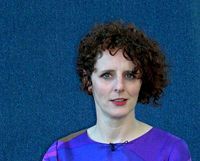
“What are you supposed to do with all the love you have for somebody if that person is no longer there? What happens to all that leftover love? Do you suppress it? Do you ignore it? Are you supposed to give it to someone else?”
―
Maggie O'Farrell,
After You'd Gone
“What is given may be taken away, at any time. Cruelty and devastation wait for you around corners, inside coffers, behind doors: they can leap out at you at any time, like a thief or brigand. The trick is never to let down your guard. Never think you are safe. Never take for granted that your children's hearts beat, that they sup milk, that they draw breath, that they walk and speak and smile and argue and play. Never for a moment forget they may be gone, snatched from you, in the blink of an eye, borne away from you like thistledown.” ― Maggie O'Farrell, Hamnet
“We are all, Esme decides, just vessels through which identities pass: we are lent features, gestures, habits, then we hand them on. Nothing is our own. We begin in the world as anagrams of our antecedents.” ― Maggie O'Farrell, The Vanishing Act of Esme Lennox
“Anyone, Eliza is thinking, who describes dying as ‘slipping away’ or ‘peaceful’ has never witnessed it happen. Death is violent, death is a struggle. The body clings to life, as ivy to a wall, and will not easily let go, will not surrender its grip without a fight.” ― Maggie O'Farrell, Hamnet
“I find,' he says, his voice still muffled, 'that I am constantly wondering where he is. Where he has gone. It is like a wheel ceaselessly turning at the back of my mind. Whatever I am doing, wherever I am, I am thinking: Where is he, where is he? He can't have just vanished. He must be somewhere. All I have to do is find him. I look for him everywhere, in every street, in every crowd, in every audience. That's what I am doing, when I look out at them all: I try to find him, or a version of him.” ― Maggie O'Farrell, Hamnet
“We are, all of us, wandering about in a state of oblivion, borrowing our time, seizing our days, escaping our fates, slipping through loopholes, unaware of when the axe may fall.” ― Maggie O'Farrell, I Am, I Am, I Am: Seventeen Brushes With Death
“Every life has its kernel, its hub, its epicentre, from which everything flows out, to which everything returns.” ― Maggie O'Farrell, Hamnet
“She, like all mothers, constantly casts out her thoughts, like fishing lines, towards her children, reminding herself of where they are, what they are doing, how they fare. From habit, while she sits there near the fireplace, some part of her mind is tabulating them and their whereabouts: Judith, upstairs. Susanna, next door. And Hamnet? Her unconscious mind casts, again and again, puzzled by the lack of bite, by the answer she keeps giving it: he is dead, he is gone. And Hamnet? The mind will ask again. At school, at play, out at the river? And Hamnet? And Hamnet? Where is he? Here, she tries to tell herself. Cold and lifeless, on this board, right in front of you. Look, here, see. And Hamnet? Where is” ― Maggie O'Farrell, Hamnet
“She grows up feeling wrong, out of place, too dark, too tall, too unruly, too opinionated, too silent, too strange. She grows up with the awareness that she is merely tolerated, an irritant, useless, that she does not deserve love, that she will need to change herself substantially, crush herself down if she is to be married.” ― Maggie O'Farrell, Hamnet
“Partings are strange. It seems so simple: one minute ago, four, five, he was here, at her side; now, he is gone. She was with him; she is alone. She feels exposed, chill, peeled like an onion.” ― Maggie O'Farrell, Hamnet
“She has spent most of the day reading and is feeling rather out of touch with reality, as if her own life has become insubstantial in the face of the fiction she's been absorbed in.” ― Maggie O'Farrell, After You'd Gone
“That the things in life which don't go to plan are usually more important, more formative, in the long run, than the things that do” ― Maggie O'Farrell, I Am, I Am, I Am: Seventeen Brushes With Death
“I don't believe in fate. I don't believe in cushioning your insecurities with a system of belief that tells you 'Don't worry. This may be your life but you're not in control. There is something or someone looking out for you -- it's already organised.' It's all chance and choice, which is far more frightening.” ― Maggie O'Farrell, After You'd Gone
“What is the word, Judith asks her mother, for someone who was a twin but is no longer a twin?” ― Maggie O'Farrell, Hamnet
“He has, Anges sees, done what any father would wish to do, to exchange his child’s suffering for his own, to take his place, to offer himself up in his child’s stead so that the boy might live.” ― Maggie O'Farrell, Hamnet
“time runs only one way.” ― Maggie O'Farrell, Hamnet
“He feels again the sensation he has had all his life: that she is the other side to him, that they fit together, him and her, like two halves of a walnut. That without her he is incomplete, lost. He will carry an open wound, down his side, for the rest of his life, where she had been ripped from him. How can he live without her? He cannot. It is like asking the heart to live without the lungs, like tearing the moon out of the sky and asking the stars to do its work, like expecting the barley to grow without the rain.” ― Maggie O'Farrell, Hamnet
“Why isn't life better designed so it warns you when terrible things are about to happen?” ― Maggie O'Farrell, After You'd Gone
“And there, by the fire, held in the arms of his mother, in the room in which he learnt to crawl, to eat, to walk, to speak, Hamnet takes his last breath. He draws it in, he lets it out. Then there is silence, stillness. Nothing more.” ― Maggie O'Farrell, Hamnet