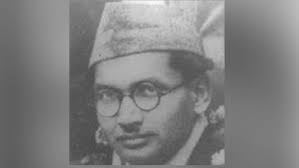

MANMATHNATH GUPTA saw the little candles burning in the white heat of melting wax through his thick optical lenses, brooded for a while and retired to his bed on Divali night. And then he slept and slept — and slept. Maya, his wife, discovered his death, remembered the massive man's last looming posture on the verandah of their house in New Delhi's Nizamuddin in the soft immensity of a velvety night punctuated by self-consuming luminous sticks. And she began to "do the needful" — informing her two sons and me, among others. She is Ramakrishna's biographer and has the Swami's peace. Her tears flow in as her fine arts flow out.
Manmathnath Gupta was happy to have "breathed and lived upon this gloomy earth", she said on the telephone in a calm voice and measured tone and ordered me not to be driven for the funeral in a hurry. I had a five-generation link with him. My grandfather, a British stooge, hated him when he conversed with my father, his soul-mate, who died young. I was part of his psyche, my son called him Bade Dadaji and my little grandson sat on his lap and played with his spectacles — and vision —in Chandigarh.
Many of our readers will ask: "Keda or kaun Manmathnath?" Briefly, the 91-year-old relentless revolutionary, freedom fighters' think tank, an authentic historian of the freedom movement, a writer of about 120 books of fiction, literary criticism and satire and works of plain truth in Hindi, English and Bengali, spent more than 20 years in British jails — mostly in "Kalapani" — because he was convicted at a very young age and, therefore, could not be hanged like Ram Prasad Bismil, Ashfaqullah, Roshan Singh and Rajendranath Lahiri. He was released when freedom came.
Manmathnath Gupta (known as Baba to thousands of people) edited, with Mr H.Y. Sararda Prasad, the Planning Commission's prestigious publications and no lesser person than the venerable H.Y.S.P. can speak authentically of him. He hated "lyrical eunuchs" and showed them the way by writing understandably suggestive and transparent novels like "Toram Phoram", "Din Dahare" and "Shahadatnama". You can identify all the major characters — mostly crooks — in them.
We often used to talk of his favourite author Vladimir Mayakovsky in whose style he used to say: For the sake of a single expression you expend thousands of tonnes of verbal ore. But how much more heat arises from the combustion of those words than from the smouldering of raw verbal material! Words send in motion millions of hearts for thousands of years.