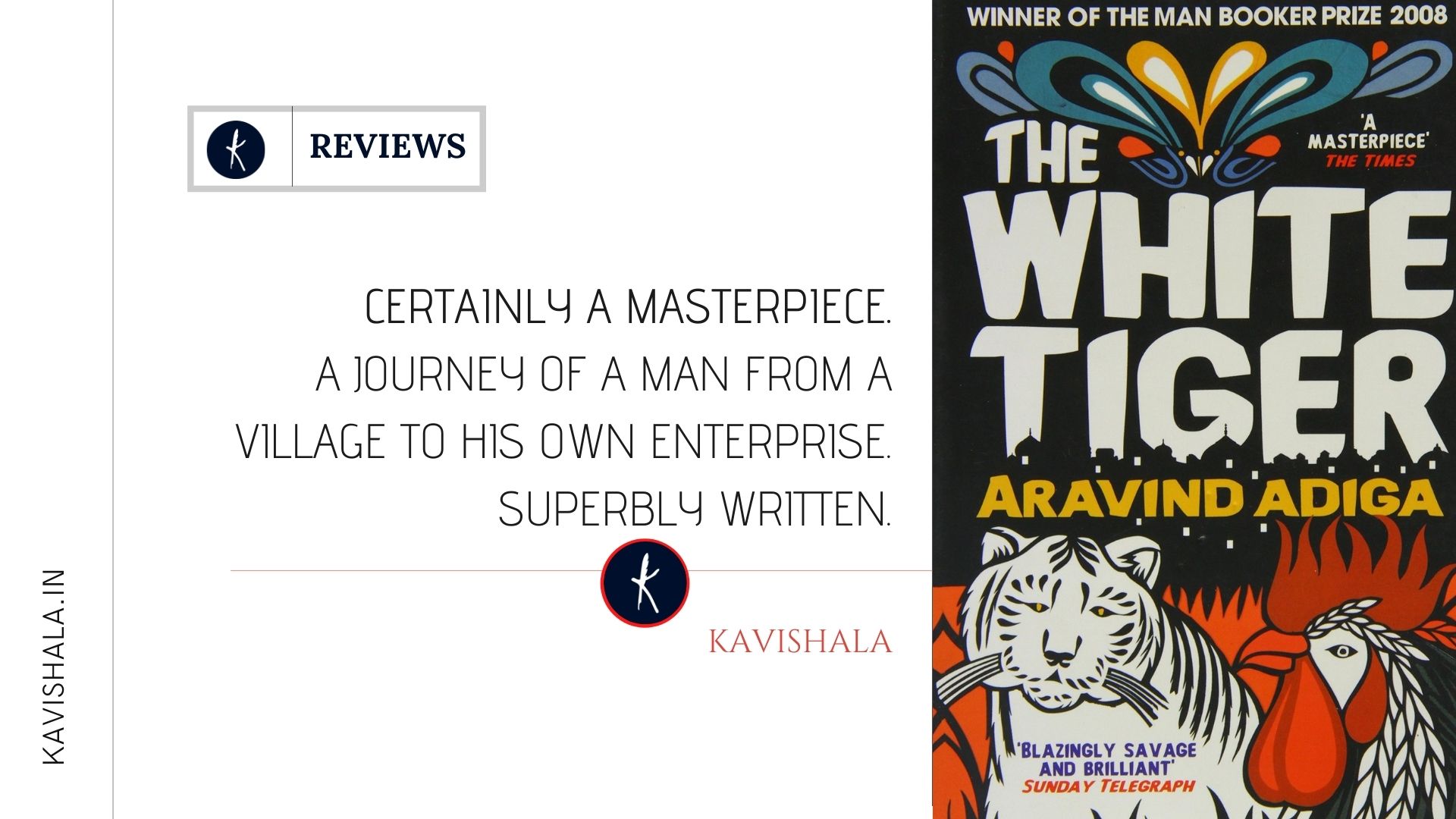

[The White Tiger Novel by Aravind Adiga]
Meet Balram Halwai, the 'White tiger': servant, philosopher, entrepreneur, murderer... Born in a village in the heart of India, The son of a rickshaw Puller, Balram is taken out of school and put to work in a teashop. As he crushes coal and wipes tables, he nurses a dream of escape. His big chance comes when a rich landlord hires him as a chauffeur for his son, daughter-in-law, and their two pomeranian dogs. From behind the wheels of a honda, Balram sees Delhi and begins to see how the tiger might escape his cage. For surely any successful man must spill a little blood on his way to the top? The White tiger is a tale of two India's. Balram's journey from the darkness of village life to the light of entrepreneurial success is utterly amoral, brilliantly irreverent, deeply endearing, and altogether unforgettable.
A book that empathized every angle of the downtrodden and the helpless servants. Through the character Balram Halwai, Adiga has brought out the "so-called" democracy, the corruption, the freedom that every servant longs in the basement of a gigantic apartment of the city, the dowry, and all the themes that make the poor people powerless. His wizardry of metaphorical characterization is so compelling to pick this book. Not only Balram, with this kind of a novel, but Aravind Adiga himself is 'THE WHITE TIGER'. Lastly, his predictions on Bangalore is terrific and left me without words to describe. Loved it!
About the Author: Aravind Adiga was born in 1974 in Madras (now called Chennai) and grew up in Mangalore in the south of India. He was educated at Columbia University in New York and Magdalen College, Oxford. His articles have appeared in publications such as The New Yorker, The Sunday Times, The Financial Times, and the Times of India. The White Tiger is his first novel and it won the Man Booker Prize for fiction in 2008.
The White Tiger is the debut novel by Indian author Aravind Adiga. It was first published in 2008 and won the 40th Man Booker Prize in the same year. The novel provides a darkly humorous perspective of India's class struggle in a globalized world as told through a retrospective narration from Balram Halwai, a village boy. In detailing Balram's journey first to Delhi, where he works as a chauffeur to a rich landlord, and then to Bangalore, the place to which he flees after killing his master and stealing his money, the novel examines issues of the Hindu religion, caste, loyalty, corruption and poverty in India. Ultimately, Balram transcends his sweet-maker caste and becomes a successful entrepreneur, establishing his own taxi service. In a nation proudly shedding a history of poverty and underdevelopment, he represents, as he himself says, "tomorrow." The novel has been well-received, making the New York Times bestseller list in addition to winning the Man Booker Prize. Aravind Adiga, 33 at the time, was the second youngest writer as well as the fourth debut writer to win the prize in 2008. Adiga says his novel "attempt to catch the voice of the men you meet as you travel through India — the voice of the colossal underclass." According to Adiga, the exigence for The White Tiger was to capture the unspoken voice of people from "the Darkness" – the impoverished areas of rural India, and he "wanted to do so without sentimentality or portraying them as mirthless humorless weaklings as they are usually."
Balram Halwai narrates his life in a letter, written in seven consecutive nights and addressed to the Chinese Premier, Wen Jiabao. In his letter, Balram explains how he, the son of a puller, escaped a life of servitude to become a successful businessman, describing himself as an entrepreneur.
Balram was born in a rural village in Gaya district, where he lived with his grandmother, parents, brother and extended family. He is a smart child but is forced to leave school in order to help pay for his cousin's dowry and begins to work in a teashop with his brother in Dhanbad. While working there he begins to learn about India's government and economy from the customers' conversations. Balram describes himself as a bad servant but a good listener and decides to become a driver.
After learning how to drive, Balram finds a job driving Ashok, the son of one of Laxmangarh's landlords. He takes over the job of the main driver, from a small car to a heavy-luxury described Honda City. He stops sending money back to his family and disrespects his grandmother during a trip back to his village. Balram moves to New Delhi with Ashok and his wife Pinky Madam. Throughout their time in Delhi, Balram is exposed to extensive corruption, especially in the government. In Delhi, the contrast between the poor and the wealthy is made even more evident by their proximity to one another.
One night Pinky Madam takes the wheel from Balram, while drunk, hits something in the road and drives away; we are left to assume that she has killed a child. Ashok's family puts pressure on Balram to confess that he had been driving alone. Ashok becomes increasingly involved in bribing government officials for the benefit of the family coal business. Balram then decides that killing Ashok will be the only way to escape India's Rooster Coop – Balram's metaphor for describing the oppression of India's poor, just as roosters in a coop at the market watch themselves get slaughtered one by one, but are unable or unwilling to break out of the cage. Similarly, Ashok too is portrayed as being trapped in the metaphorical Rooster Coop: his family controls what he does and society dictates how he acts.
After killing Ashok by bludgeoning him with a bottle and stealing the large bribe Ashok was carrying with him, Balram moves to Bangalore, where he bribes the police in order to help start his own taxi business.
Just like Ashok, Balram pays off a family whose son one of his taxi drivers hit and killed. Balram explains that his own family was almost certainly killed by Ashok's relatives as retribution for his murder. At the end of the novel, Balram rationalizes his actions and considers that his freedom is worth the lives of his family and of Ashok. And thus ends the letter to Jiabao, letting the reader think of the dark humour of the tale, as well as the idea of life as a trap introduced by the writer.