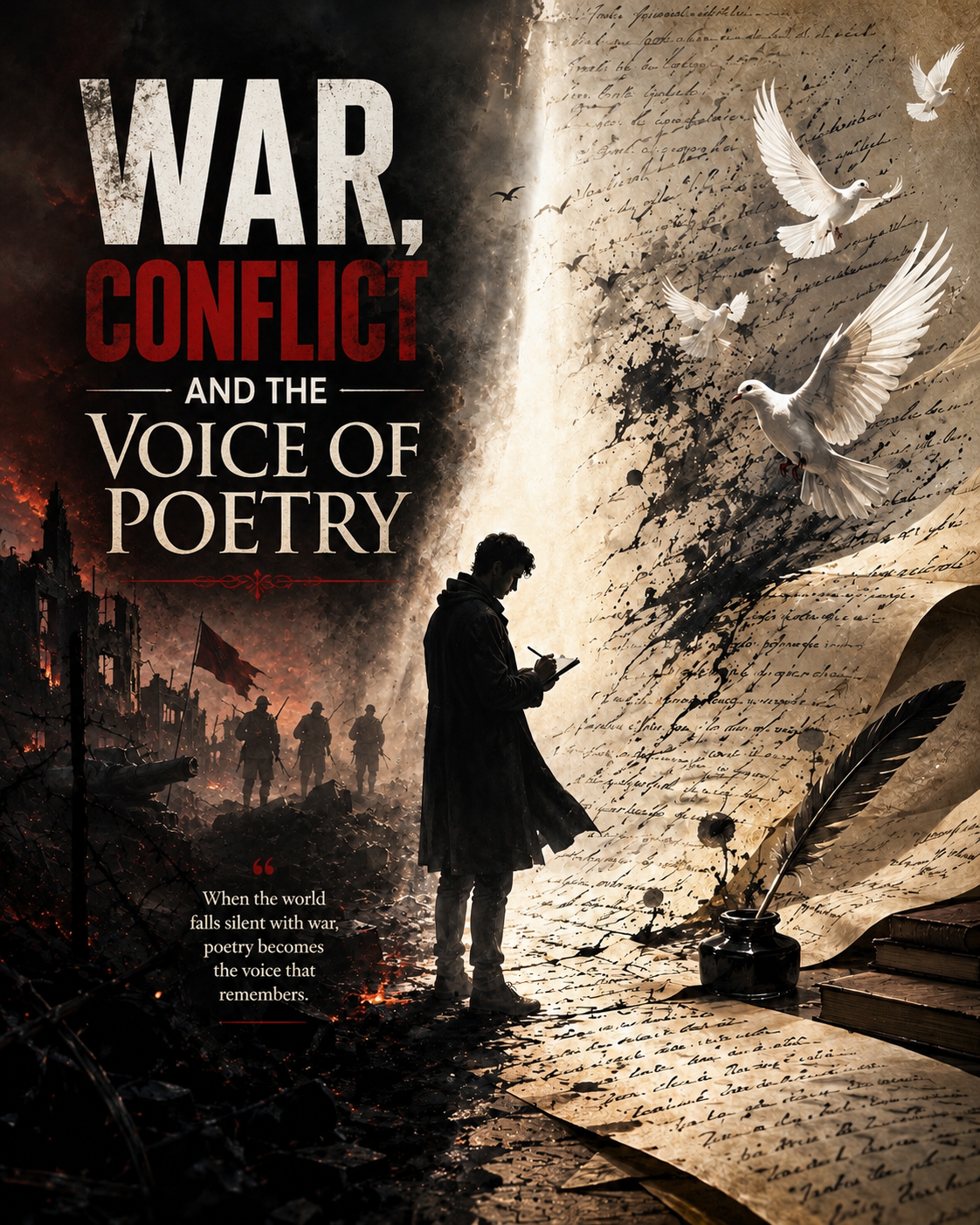

Wars,conflicts and the voice of poetry
Today's world is seeing continuous wars, conflicts, and humanitarian crises, from the Russia-Ukraine war for years to the recent US invasion in Venezuela and ongoing US-Iran tensions. These wars, these rivers of tears and blood, and these blood-thirsty, greedy people fighting and killing innocent ones are not new to mankind. These are from the start of time, sometimes with the name of Hitler, sometimes with the name of Aurangzeb, sometimes without even a famous name, but humanity is fighting these evil forces with emotions and love. Thus, poetry is a voice of humanity in these situations.
Whenever nations go to war, governments speak the language of strategy, security, territory, and military strength. However, poetry speaks a different language. Poetry speaks the language of tears, moaning, and crying. Poetry speaks the language of the mother who lost her son, the sister who lost her brother, and the wife who lost the love of her life. Poetry speaks the language of a common man who is suffering from hunger and continuous trauma.
History, after war, just keeps the statistical data, like how many people died, but poetry and literature keep the voices of people alive. No history book can ever explain the pain of Partition better than Saadat Hasan Manto's work. War creates headlines, but poetry creates memories. At times of war, poetry speaks for humanity. It does not count the number of tanks and missiles, but counts the number of families separated and the number of houses broken.
At the same time, poetry is not only about tears; it is also about the flame that rises from tears. Poetry also gives strength to people to fight against injustice and to fight for their rights. The verses of Kabir and the couplets of Faiz Ahmed Faiz always fight for the light of truth and are never afraid to speak against the darkness of injustice. It teaches us that silence in the face of suffering is also a form of participation. Therefore, poetry asks difficult questions to all sides in a conflict.
The ongoing wars and global controversies are not merely political events; they are human tragedies unfolding before our eyes. While diplomacy seeks agreements and armies seek victories, poetry seeks understanding. Poetry and shayari remind us that behind every conflict are ordinary people who desire dignity, peace, and hope. In a world increasingly divided by power and politics, poetry remains one of the few voices that continues to speak for humanity as a whole.