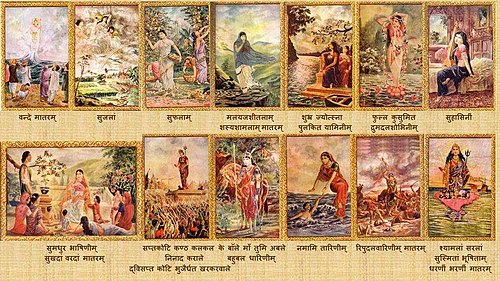

Vande Mataram is a poem written by Bankim Chandra Chatterjee in 1870s, which he included in his 1882 Bengali novel Anandamath. The poem was first sung by Rabindranath Tagore in 1896. The first two verses of the song were adopted as the National Song of India in October 1937 by the Congress Working Committee prior to the end of colonial rule in August 1947.
वन्दे मातरम्।
सुजलाम् सुफलाम्
मलयजशीतलाम्
शस्यश्यामला मातरम्।
वन्दे मातरम्।
शुभ्रज्योत्स्नाम्
पुलकितयामिनीम्
फुल्लकुसुमित
द्रुमदलशोभिनीम्
सुहासिनीम्
सुमधुर भाषिणीम्
सुखदाम् वरदाम्
मातरम्।।
वन्दे मातरम्।
------------------------------------------
বন্দে মাতরম্৷
সুজলাং সুফলাং
মলয়জশীতলাম্
শস্যশ্যামলাং
মাতরম্!
বন্দে মাতরম্৷.
শুভ্র-জ্যোৎস্না
পুলকিত-যামিনীম্
ফুল্লকুসুমিত
দ্রুমদলশোভিনীম্,
সুহাসিনীং
সুমধুরভাষিণীম্
সুখদাং বরদাং
মাতরম্৷৷
বন্দে মাতরম্৷
------------------------------------------
Vônde matôrôm
sujôlang suphôlang
môlôyôjôshitôlam
shôsyô shyamôlang
matôrôm
vônde matôrôm
shubhrô jyotsna
pulôkitô jaminim
phullô kusumitô
drumôdôlôshobhinim
suhasining
sumôdhurôbhashini
sukhôdang bôrôdang
matôrôm
vônde matôrôm
------------------------------------------
vande mātaram
sujalāṃ suphalāṃ
malayajaśītalām
śasya śyāmalāṃ
mātaram
vande mātaram
śubhra jyotsnām
pulakita yāminīm
phoolla kusumita
droomadalaśobhinīm
suhāsinīṃ
sumadhuram bhāṣiṇīm
sukhadāṃ varadāṃ
mātaram
vande mātaram
(Sanskrit)
The first translation of Bankim Chandra Chattopadhyay's novel Anandamath, including the poem Vande Mataram, into English was by Nares Chandra Sen-Gupta, with the fifth edition published in 1906 titled "The Abbey of Bliss". Here is the translation in prose of the above two stanzas rendered by Sri Aurobindo Ghosh. This has also been adopted by the Government of India's national portal. The original Vande Mataram consists of six stanzas and the translation in prose for the complete poem by Shri Aurobindo appeared in Karmayogin, 20 November 1909.
Mother, I praise thee!
Rich with thy hurrying streams,
bright with orchard gleams,
Cool with thy winds of delight,
Dark fields waving Mother of might,
Mother free.
Glory of moonlight dreams,
Over thy branches and lordly streams,
Clad in thy blossoming trees,
Mother, giver of ease
Laughing low and sweet!
Mother I kiss thy feet,
Speaker sweet and low!
Mother, to thee I praise thee. [Verse 1]
Who hath said thou art weak in thy lands
When the swords flash out in seventy million hands
And seventy million voices roar
Thy dreadful name from shore to shore?
With many strengths who art mighty and stored,
To thee I call Mother and Lord!
Thou who savest, arise and save!
To her I cry who ever her foeman drove
Back from plain and Sea
And shook herself free. [Verse 2]
Thou art wisdom, thou art law,
Thou art heart, our soul, our breath
Thou art love divine, the awe
In our hearts that conquers death.
Thine the strength that nerves the arm,
Thine the beauty, thine the charm.
Every image made divine
In our temples is but thine. [Verse 3]
Thou art Durga, Lady and Queen,
With her hands that strike and her swords of sheen,
Thou art Lakshmi lotus-throned,
And the Muse a hundred-toned,
Pure and perfect without peer,
Mother lend thine ear,
Rich with thy hurrying streams,
Bright with thy orchard gleems,
Dark of hue O candid-fair [Verse 4]
In thy soul, with bejeweled hair
And thy glorious smile divine,
Loveliest of all earthly lands,
Showering wealth from well-stored hands!
Mother, mother mine!
Mother sweet, I praise thee,
Mother great and free! [Verse 5]
Apart from the above prose translation, Sri Aurobindo also translated Vande Mataram into a verse form known as Mother, I praise thee!. Sri Aurobindo commented on his English translation of the poem that "It is difficult to translate the National Song of India into verse in another language owing to its unique union of sweetness, simple directness and high poetic force."
Translation into other languages
Vande Mataram has inspired many Indian poets and has been translated into numerous Indian languages, such as Tamil, Telugu, Kannada, Malayalam, Assamese, Hindi, Marathi, Gujarati, Punjabi Urdu and others.
Arif Mohammad Khan translated Vande Mataram in Urdu. It can be read in Urdu (Devanagari script) as:
तस्लीमात, मां तस्लीमात
तू भरी है मीठे पानी से
फल फूलों की शादाबी से
दक्खिन की ठंडी हवाओं से
फसलों की सुहानी फिजाओं से
तस्लीमात, मां तस्लीमात
तेरी रातें रोशन चांद से
तेरी रौनक सब्ज-ए-फाम से
तेरी प्यार भरी मुस्कान है
तेरी मीठी बहुत जुबान है
तेरी बांहों में मेरी राहत है
तेरे कदमों में मेरी जन्नत है
तस्लीमात, मां तस्लीमात
History and significance
Bankim Chandra Chatterjee was one of the earliest graduates of the newly established Calcutta University. After his BA, he joined the British Indian government as a civil servant, becoming a Deputy Collector and later a Deputy Magistrate. Chattopadhyay was very interested in recent events in Indian and Bengali history, particularly the Revolt of 1857 and the previous century's Sanyasi Rebellion. Around the same time, the administration was trying to promote "God Save the Queen" as the anthem for Indian subjects, which Indian nationalists disliked. It is generally believed that the concept of Vande Mataram came to Bankim Chandra Chattopadhyay when he was still a government official, around 1876. He wrote Vande Mataram at Chinsura(Chuchura), there is a white colour house of Adhya Family near river Hooghly (near Mallik Ghat).[citation needed] Chattopadhyay wrote the poem in a spontaneous session using words from Sanskrit and Bengali. The poem was published in Chattopadhyay's book Anandamath (pronounced Anondomôţh in Bengali) in 1882, which is set in the events of the Sannyasi Rebellion. Jadunath Bhattacharya was asked to set a tune for this poem just after it was written.
Debate on adoption as national song of India
Parts of the Vande Mataram was chosen as the national song in 1937 by the Indian National Congress as it pursued independence of India from the British colonial rule, after a committee consisting of Maulana Azad, Jawaharlal Nehru, Subhash Bose, Acharya Deva and Rabrindanath Tagore recommended the adoption. The entire song was not selected by Hindu leaders in order to respect the sentiments of non-Hindus, and the gathering agreed that anyone should be free to sing an alternate "unobjectionable song" at a national gathering if they do not want to sing Vande Mataram because they find it "objectionable" for a personal reason. According to the gathered leaders, including the Nobel Laureate Rabindranath Tagore, though the first two stanzas began with an unexceptionable evocation of the beauty of the motherland, in later stanzas there are references to the Hindu goddess Durga. The Muslim League and Muhammad Ali Jinnah opposed the song. Thereafter, with the support of Mahatma Gandhi and Jawahar Lal Nehru, the Indian National Congress decided to adopt only the first two stanzas as the national song to be sung at public gatherings, and other verses that included references to Durga and Lakshmi were expunged.
Rajendra Prasad, who was presiding the Constituent Assembly on 24 January 1950, made the following statement which was also adopted as the final decision on the issue:
...The composition consisting of the words and music known as Jana Gana Mana is the National Anthem of India, subject to such alterations in the words as the Government may authorise as occasion arises; and the song Vande Mataram, which has played a historic part in the struggle for Indian freedom, shall be honoured equally with Jana Gana Mana and shall have equal status with it. (Applause). I hope this will satisfy the Members.
On 24 January 1950, the Constituent Assembly of India has adopted "Vande Mataram" as national song.
On the occasion, the first President of India, Rajendra Prasad stated that the song should be honoured equally with the national anthem of India, "Jana Gana Mana". However the Constitution of India does not have any mention of "national song".