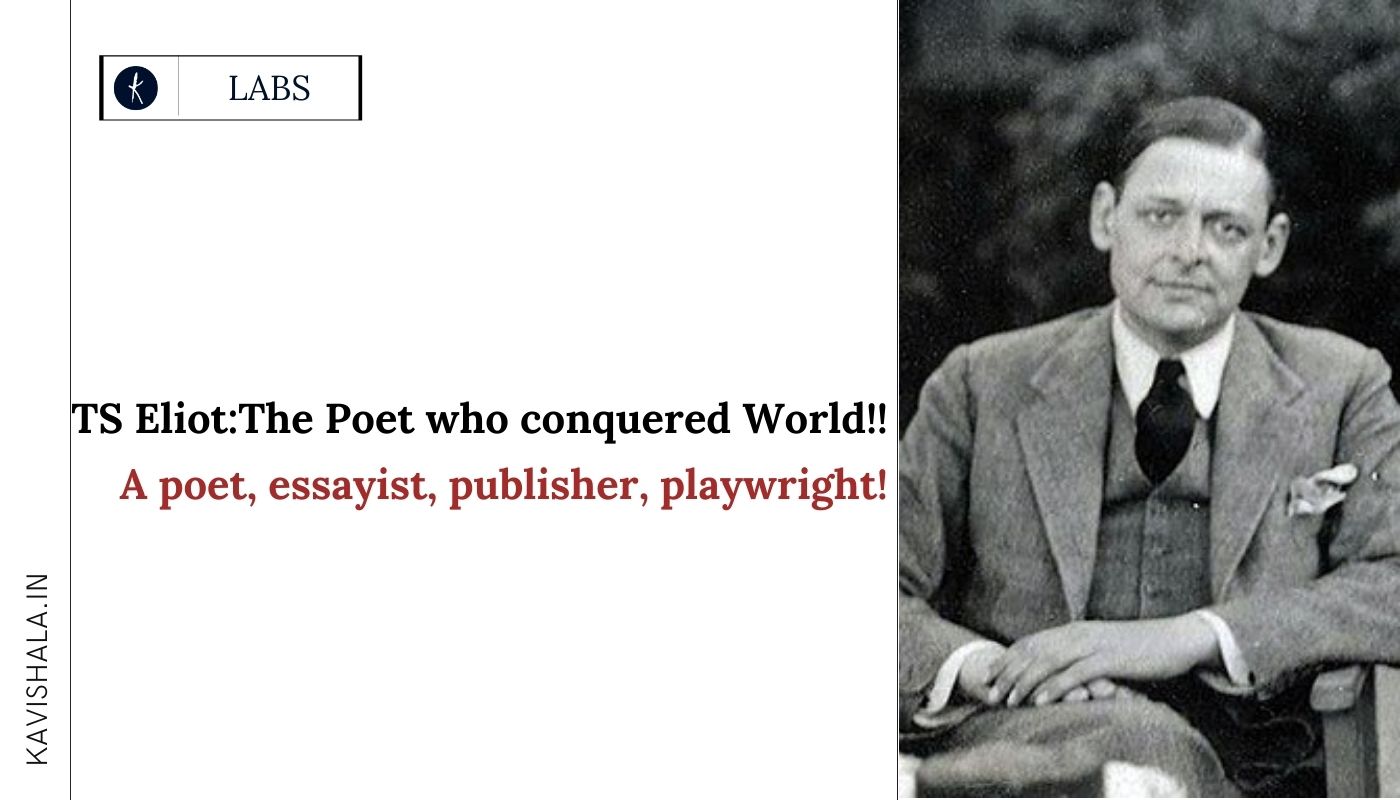

Thomas Stearns Eliot was an outstanding poet, essayist, publisher, playwright, literary critic, and editor. Considered as one of the 20th century's major poets, he is a central figure in English-language modernist poetry.
Born in St. Louis, Missouri, to a prominent Boston Brahmin family, he moved to England in 1914 at the age of 25 years and went on to settle, work, and marry there. He became a British Citizen in 1927 at the age of 39, subsequently renouncing his American citizenship.
Being a subversive outsider, he became the most celebrated poet of the 20th century – a world poet, who changed the way we think.
The young immigrant poet got a rejection for his poem disappointingly puritanical. But four years earlier, at the age of 22, he had completed his first masterpiece.
At least one editor considered it's borderline insane; another was “unable to make head or tail” of it. Its title was “The Love Song of J Alfred Prufrock”.
Prufrock’s “Love Song” first appeared in the US, tucked away towards the back of a small magazine, probably because the editor did not greatly care for it.
Whispers of Immortality
-by T. S. Eliot
WEBSTER was much possessed by death
And saw the skull beneath the skin;
And breastless creatures underground
Leaned backward with a lipless grin.
Daffodil bulbs instead of balls
Stared from the sockets of the eyes!
He knew that thought clings round dead limbs
Tightening its lusts and luxuries.
Donne, I suppose, was such another
Who found no substitute for sense,
To seize and clutch and penetrate;
Expert beyond experience,
He knew the anguish of the marrow
The ague of the skeleton;
No contact possible to flesh
Allayed the fever of the bone.
. . . . .
Grishko is nice: her Russian eye
Is underlined for emphasis;
Uncorseted, her friendly bust
Gives promise of pneumatic bliss.
The couched Brazilian jaguar
Compels the scampering marmoset
With subtle effluence of cat;
Grishko has a maisonette;
The sleek Brazilian jaguar
Does not in its arboreal gloom
Distill so rank a feline smell
As Grishkin in a drawing-room.
And even the Abstract Entities
Circumambulate her charm;
But our lot crawls between dry ribs
To keep our metaphysics warm.
However, Eliot’s reputation has taken a battering in recent decades. In particular, he has been accused of antisemitism – a charge he denied. There is clear evidence that his parents shared a markedly antisemitic prejudice, and it is hard to argue convincingly that Eliot completely outgrew this. Surprisingly, he was both preternaturally gifted and undeniably a man of his time.