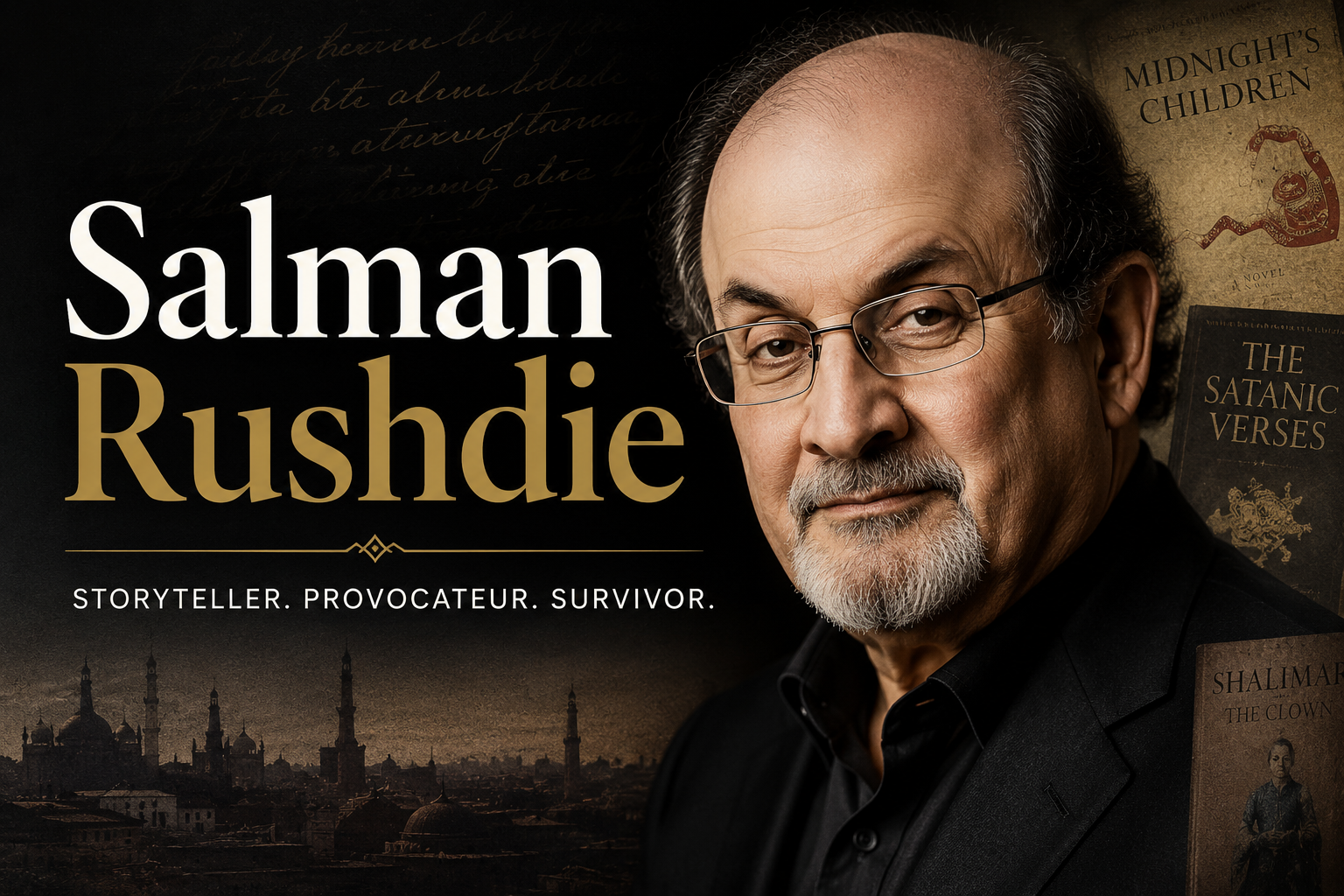

Salman Rushdie - A Writer Who Lives Stories
Salman Rushdie is not merely an ordinary novelist but a compact personality; his novels do not tell a story, but they live that story. Through them, the reader feels the emotions hidden in the words and letters. Salman Rushdie is also a face of freedom of expression, as he expressed himself even while facing a lot of threats and violent criticism.
Rushdie was born in Bombay (nowadays Mumbai) at the time of partition, at the time of violence and streets full of blood; yes, he was born on 19th June 1947. Rushdie grew up amid stories of migration, memory, and changing identities. These experiences would later find their way into fiction. He completed his education in England, where he developed a literary voice that has both Indian folklore and history and Western literary traditions as elements. His thoughts and stories are deeply political.
Rushdie became famous with his exceptional work Midnight's Children in 1981. More than just a novel, it was a vibrant retelling of India's journey after independence through the life of a child born at the stroke of midnight on 15th August 1947. The novel won the Booker Prize and secured Rushdie's place among the most significant English-language writers of his generation.
Salman Rushdie's name is not only remembered for his literary contributions but also for his bravery as a writer and human. His life often revolves around difficult conversations about religion, politics, freedom, and the responsibilities of writers. The publication of The Satanic Verses in 1988 led to one of the most intense controversies in modern literary history. Protests erupted in several countries, and a fatwa calling for his death was also issued. For years, he lived under security and faced many troubles, but despite all these, he never stopped speaking and writing what he wanted. This makes him a symbol of freedom.
The other famous works of Salman are Shame (1983), Haroun and the Sea of Stories, The Moor's Last Sigh, Victory City, etc.
In an age where opinions are quickly judged and public debates often leave little room for nuance, Salman Rushdie's story invites us to reconsider the place of literature in society. Perhaps the true purpose of great writing is not to comfort us with familiar ideas but to encourage us to think, question, and engage with perspectives beyond our own. In that sense, Salman Rushdie remains not just a novelist but a testament to the resilience of the written word.