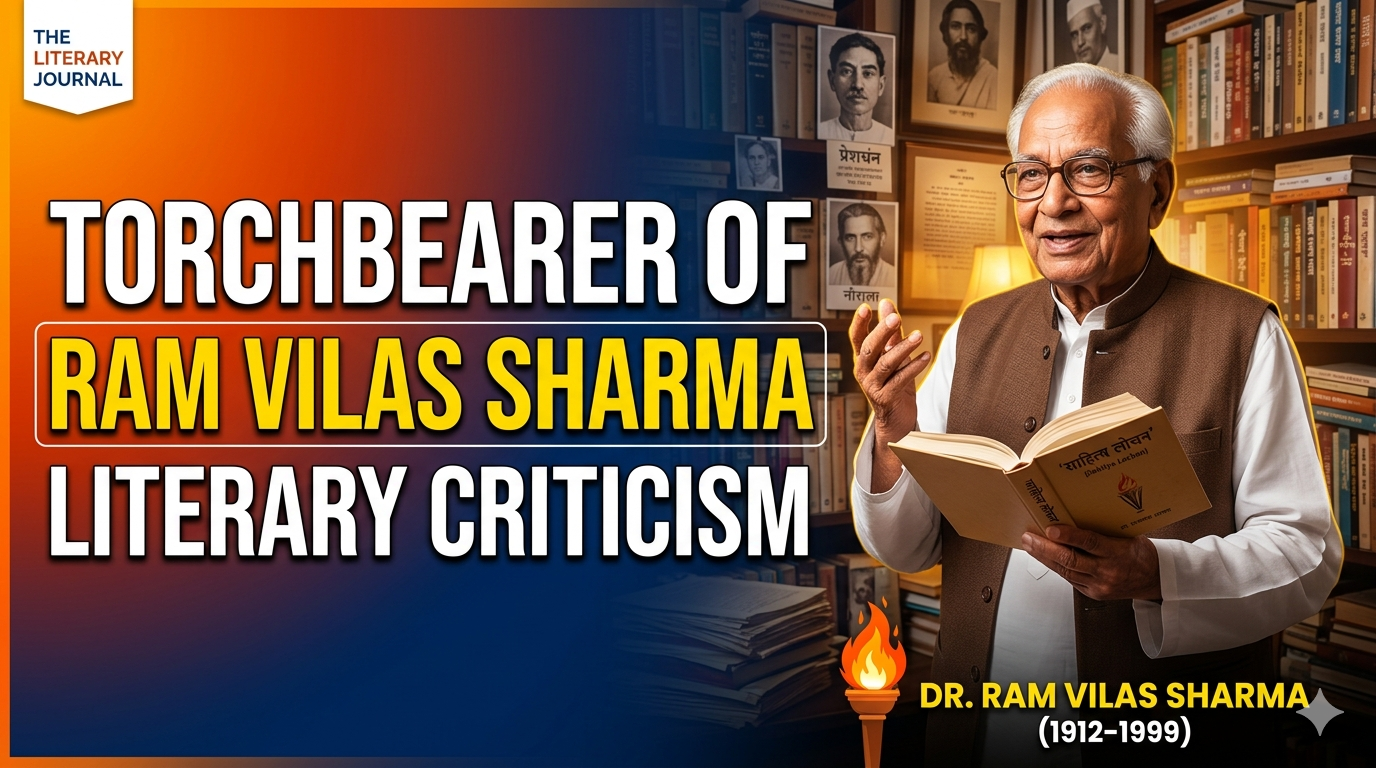

Ram Vilas Sharma – Torchbearer of Literary Criticism
In the vast landscape of modern Hindi criticism, Ram Vilas Sharma is one of the most prominent names. He did not see literature merely as an artistic exercise but as a living social force which shapes our society, politics, and our way of thinking. Sharma was a scholar, linguist, Marxist critic, historian of ideas, and relentless public intellectual. His work reshaped Hindi literary criticism in the twentieth century and gave it a historical and ideological depth that continues to influence scholars even today.
Ram Vilas Sharma was born on 10 October 1912 in the village of Unchgaon Sani in Uttar Pradesh’s Unnao district. Ram Vilas Sharma emerged as a great intellectual from North India at a time of colonial rule when North India and the Hindi region were witnessing a lot of political and cultural churn. The modest environment of Sharma’s early life played a vital role in shaping his intellectual temperament. Unlike most metropolitan critics, Sharma carried with him a close familiarity with village life. He became the voice of ordinary Indians in the elite circle of literary critics. Sharma completed his higher studies at the University of Lucknow, where he specialized in English literature. After that, he entered academia but never allowed himself to become confined within institutional boundaries.
In his personal life, Sharma was a person who remained deeply immersed in books. He was known for his austere lifestyle and uncompromising discipline. Even after being intellectually rigorous, he remained emotionally rooted in the concerns of common society. He was not a literary celebrity who cultivated glamour or public spectacle. Instead, he belonged to the tradition of scholar-critics whose authority arose from years of painstaking study and ideological commitment.
Ram Vilas Sharma brought Marxist methodology and ideology to interpret Hindi literature and writers. He did not simply adopt it from the West but transformed it for the Indian context. Ram Vilas Sharma's most celebrated work is on Suryakant Tripathi Nirala, titled Nirala Ki Sahitya Sadhana. In this book, he not only explored Nirala’s poetry but also the social contradictions, intellectual struggles, and emotional turbulence that shaped the poet’s vision. His other equally valuable and prominent works are Premchand Aur Unka Yug, Bhasha Aur Samaj, and Mahavir Prasad Dwivedi Aur Hindi Navjagaran. Through his work, Sharma linked literature with nationalism, class consciousness, and linguistic evolution.
He received the Sahitya Akademi Award for his exceptional contribution to Hindi literature, and he was also the first recipient of the prestigious Vyas Samman. But these awards alone are not enough to explain his contribution and achievements.
In today’s fast-communication and low-attention-span world, Ram Vilas Sharma may seem less relevant, but this is not the actual picture, as he reminds contemporary readers that criticism is not only about praise and condemnation; it must illuminate the relationship between literature, society, history, and power. After him, the place of Sharma cannot easily be taken by anyone else because of the originality of his work.