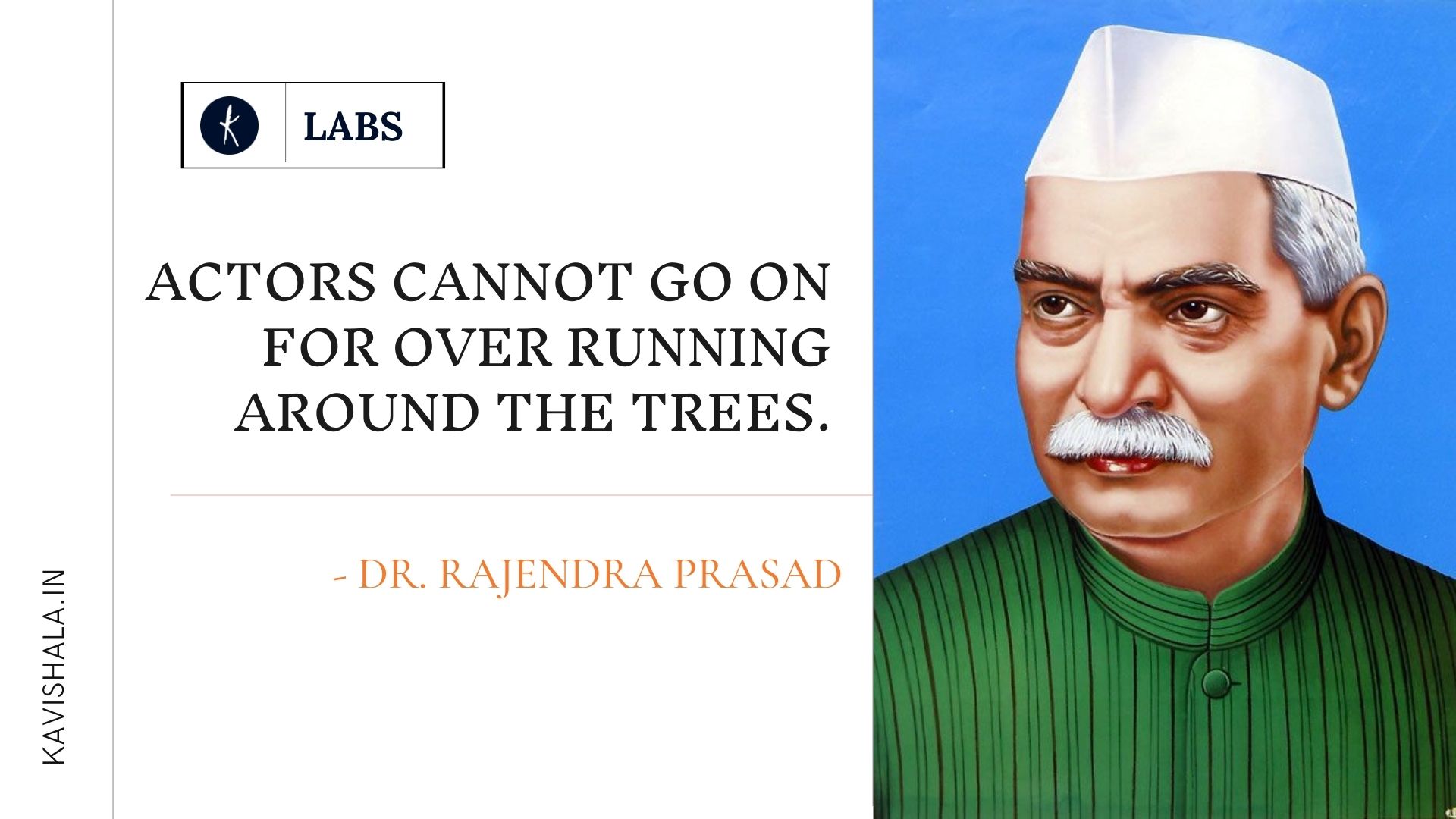

Dr. Rajendra Prasad had a major role in the independence movement. Prasad's first association with Indian National Congress was during 1906 annual session organised in Calcutta, where he participated as a volunteer, while studying in Calcutta. Formally, he joined the Indian National Congress in the year 1911, when the annual session was again held in Calcutta. During the Lucknow Session of Indian National Congress held in 1916, he met Mahatma Gandhi. During one of the fact-finding missions at Champaran, Mahatma Gandhi asked him to come with his volunteers. He was so greatly moved by the dedication, courage and conviction of Mahatma Gandhi that as soon as the motion of Non-Cooperation was passed by Indian National Congress in 1920, he retired from his lucrative career of lawyer as well as his duties in the university to aid the movement. He also responded to the call by Gandhi to boycott Western educational establishments by asking his son, Mrityunjaya Prasad, to drop out of his studies and enrol himself in Bihar Vidyapeeth, an institution he along with his colleagues founded on the traditional Indian model.
During the course of the independence movement, he interacted with Rahul Sankrityayan, a writer, and polymath. Rahul Sankrityayan was greatly influenced by Prasad's intellectual powers, finding him to be a guide and guru. In many of his articles he mentioned about his meeting with Sankrityayan and narrated about his meetings with Sankrityayan. He wrote articles for the revolutionary publications Searchlight and the Desh and collected funds for these papers. He toured widely, explaining, lecturing, and exhorting the principles of the independence movement.
Literary contributions of Dr. Rajendra Prasad:
- Satyagraha at Champaran (1922)
- Division of India (1946, online)
- Atmakatha (1946), his autobiography written during his 3-year prison term in Bankipur Jail
- Mahatma Gandhi and Bihar, Some Reminiscences(1949)
- Bapu Ke Kadmon Mein (1954)
- Since Independence (published in 1960)
- Bharatiya Shiksha
- At the feet of Mahatma Gandhi
Top 10 Inspirational Quotes by Dr. Rajendra Prasad:
1. Now I am careful about the kind of roles that I do.
2. One must learn to play one's age.
3. Age is very important in the entertainment industry.
4. I know I cannot do all the stuff that I did ten years ago.
5. Nobody can push me aside.
6. What I mean is that today's films lay lot of emphasis on glamour and associated emotions.
7. In attaining our ideals, our means should be as pure as the end!
8. More importantly, I also understand my age and am in a better position to appreciate it.
9. Actors cannot go on for over running around the trees.
10. He had a very rich background and belonged to a scholarly family.
_______________________________________________________________________________
Rajendra Prasad (3 December 1884 – 28 February 1963) was an Indian independence activist, lawyer, scholar and subsequently, the first President of India, in office from 1950 to 1962. He was an Indian political leader and lawyer by training. Prasad joined the Indian National Congress during the Indian Independence Movement and became a major leader from the region of Bihar. A supporter of Mahatma Gandhi, Prasad was imprisoned by British authorities during the Salt Satyagraha of 1931 and the Quit India movement of 1942. After the constituent assembly 1946 elections, Prasad served as Minister of Food and Agriculture in the central government. Upon independence in 1947, Prasad was elected as President of the Constituent Assembly of India, which prepared the Constitution of India and served as its provisional parliament. When India became a republic in 1950, Prasad was elected its first president by the Constituent Assembly. As president, Prasad established a tradition of non-partisanship and independence for the office-bearer, and retired from Congress party politics. Although a ceremonial head of state, Prasad encouraged the development of education in India and advised the Nehru government on several occasions. In 1957, Prasad was re-elected to the presidency, becoming the only president to serve two full terms. Prasad stayed in office for the longest term of around 12 years. Post the completion of his tenure, he quit the Congress and set up new guidelines for parliamentarians which are still followed. Prasad played a major role in forming the Bihari Students Conference in 1906 and served as the president of the Constituent Assembly that drafted the Constitution of India.
First President of Indian Republic: Two and a half years after independence, on 26 January 1950, the Constitution of independent India was ratified and Prasad was elected the nation's first president. Unfortunately, on the night of 25 January 1950, a day before the Republic Day of India, his sister Bhagwati Devi died. He arranged her cremation but only after his return from the parade ground. As President of India, he duly acted as required by the Constitution, independent of any political party. He travelled the world extensively as an ambassador of India, building diplomatic rapport with foreign nations. He was re-elected for two consecutive terms in 1952 and 1957, and is the only President of India to achieve this feat. The Mughal Gardens at the Rashtrapati Bhavan were open to public for about a month for the first time during his tenure, and since then it has been a big attraction for people in Delhi and other parts of the country. Prasad acted independently of politics, following the expected role of the president as required the constitution. Following the tussle over the enactment of the Hindu Code Bill, he took a more active role in state affairs. In 1962, after serving twelve years as the president, he announced his decision to retire. After relinquishing the office of the President of India on May 1962, he returned to Patna on 14 May 1962 and preferred to stay in the campus of Bihar Vidyapeeth. His wife died on 9 September 1962. A month before Indo-China War. He was subsequently awarded the Bharat Ratna, the nation's highest civilian award. He died on 28 February 1963, aged 78. Rajendra Smriti Sangrahalaya in Patna is dedicated to him. His wife had predeceased him by a few months.