
Definition of Poetry: Literary work in which the expression of feelings and ideas is given intensity by the use of distinctive style and rhythm; poems collectively or as a genre of literature.
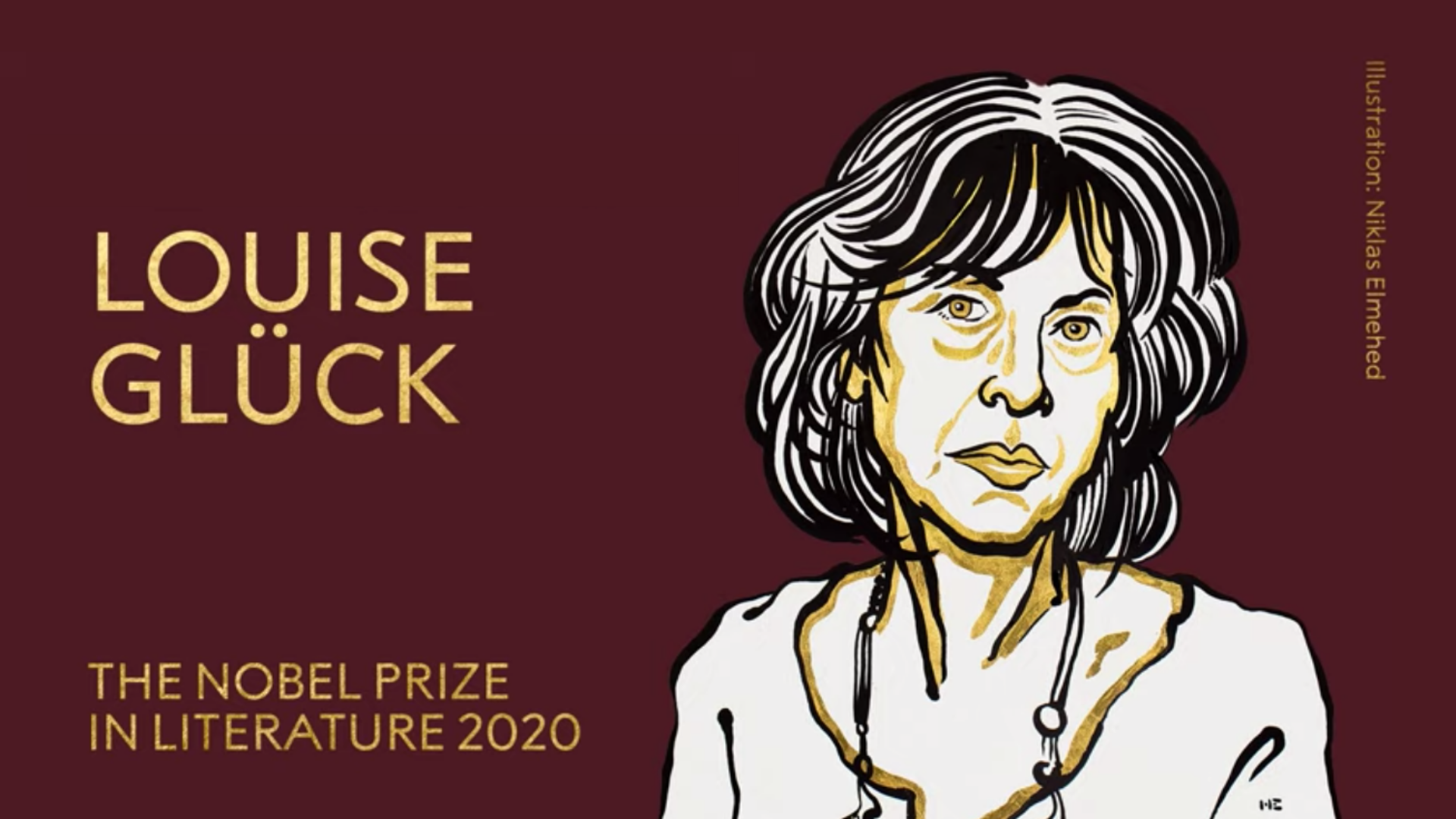
The Nobel Prize in Literature for 2020 is awarded to the American poet Louise Glück
“for her unmistakable poetic voice that with austere beauty makes individual existence universal”.
This year's Nobel Prize for Literature has been awarded to the US poet Louise Glück. As per Swedish Academy, she was recognised for "her unmistakable poetic voice, that with austere beauty makes individual existence universal".
Her poetry focuses on the painful reality of being human, dealing with themes such as death, childhood, and family life. She also takes inspiration from Greek mythology and its characters, such as Persephone and Eurydice, who are often the victims of betrayal.
This a great new for all poets of the world. Everyone is celebrating this Nobel Prize.
-----------------------------------------------------------------------------------------------
“Faithful and Virtuous Night” (2014)
Much of this collection, which won a National Book Award for poetry, is a work of fiction set in the British countryside. The book’s central orator — readers later discover — is an elderly male painter. It’s a book of reflections on mortality and the effect of mourning on art and the creative act. In a poem titled “Afterword,” Glück writes: “Fate, destiny, whose designs and warnings/ now seem to me simply/ local symmetries, metonymic/ baubles within immense confusion —/ Chaos was what I saw./ My brush froze — I could not paint it.”
A National Book Award judge said the collection “emanates from a world where darkness blurs ordinarily sharp edges around the oppositions we summon to think our lives — loss and renewal, male and female, the living and dead.”
“Poems 1962-2012” (2012)
The winner of the Los Angeles Times Book Prize in 2012 offers a complete collection of Glück’s poems to date, beginning with her debut, “Firstborn” (1968), and running through 2009’s “A Village Life.” At more than 600 pages, this anthology is a vast landscape into Glück’s poetic innovation and her pen’s deceptively simple verses that pierce at the heart. Its publication was called “a major event in this country’s literature” by the New York Times and underlines Glück’s quest to find clarity through words.
Louise Gluck's "Faithful and Virtuous Night" won the National Book Award in poetry in 2014.
(Farrar, Straus and Giroux)
“The Wild Iris” (1992)
The poems in “The Wild Iris” are about change and rebirth, filtered through the lens of nature. In the title poem, Glück writes about a flower dying and coming back to life. “It is terrible to survive/ as consciousness/ buried in the dark earth,” she writes, and later: “You who do not remember/ passage from the other world/ I tell you I could speak again: whatever/ returns from oblivion returns/ to find a voice.”
The Nobel literature committee on Thursday highlighted another poem in this collection, “Snowdrops,” documenting “the miraculous return of life after winter.” It won Glück the Pulitzer Prize for poetry in 1993.
“Ararat” (1990)
Deemed the most “brutal and sorrow-filled book of American poetry published in the past 25 years” by the New York Times in 2012, “Ararat” is a devastating, intimate and semi-autobiographical window into the life of a family — a collection of poems that captures a mother’s struggle with conveying emotion; the death of a newborn sister; a last visit with a dying father (“Terminal Resemblance”); and the challenges of parenthood. Memory and pain are unifying themes, highlighted in poems like “First Memory”:
“Long ago, I was wounded. I lived/ to revenge myself/ against my father, not/ for what he was — /for what I was: from the beginning of time,/ in childhood, I thought/ that pain meant/ I was not loved./ It meant I loved.”
“The Triumph of Achilles” (1985)
The poems in this collection are, in many ways, about possibilities. Glück reimagines ideas about family and friendships, about myth and legend, both Greek and biblical. In the poem “Winter Morning,” Glück writes about Jesus Christ: “Today, when I woke up, I asked myself/ why did Christ die? Who knows/ the meaning of such questions?”
It won the National Book Critics Circle Award for poetry in 1985.
“The voice in Glück’s poems reassures us that poetry isn’t and never has been explanatory at heart, but can become a wonder of spirit and symbol, touching love, passion, loss and suffering without romanticizing those large subjects,” said poet Holly Prado in a review for The Times in 1986. “[It] risks the criticism of being ‘difficult’ in order to send us into our own darkened questions, perhaps to discover our own voices there.”
BBC Wrote: The Academy added she was "surprised" when she received their phone call. Glück, born 1943 in New York, lives in Massachusetts and is also professor of English at Yale University. The Academy's permanent secretary Mats Malm said he had spoken to Glück just before making the announcement.
"The message came as a surprise, but a welcome one as far as I could tell," he said.
She is the fourth woman to win the prize for literature since 2010, and only the 16th since the Nobel prizes were first awarded in 1901. The last American to win was Bob Dylan in 2016.
Glück won the Pulitzer Prize in 1993 for her collection The Wild Iris and the National Book Award in 2014.
Her other honours include the 2001 Bollingen Prize for Poetry, the Wallace Stevens Award, given in 2008, and a National Humanities Medal, awarded in 2015. She was also editor of the anthology The Best American Poetry 1993.
The chair of the Nobel prize committee, Anders Olsson, also praised the poet's "candid and uncompromising" voice, which is "full of humour and biting wit".
Her 12 collections of poetry are "characterised by a striving for clarity", he added, comparing her with Emily Dickinson with her "severity and unwillingness to accept simple tenets of faith".
The prize is given to the person who has "produced in the field of literature the most outstanding work in an ideal direction".
Her poetry is characterised by "a striving for clarity", the Academy said, with a focus on childhood, family life, and close relationships between parents and siblings. "In her poems, the self listens for what is left of its dreams and delusions," the Academy said. — Reuters
Louise Glück was born in New York City in 1943 and grew up on Long Island. She attended Sarah Lawrence College and Columbia University. Considered by many to be one of America’s most talented contemporary poets, Glück is known for her poetry’s technical precision, sensitivity, and insight into loneliness, family relationships, divorce, and death. The poet Robert Hass has called her “one of the purest and most accomplished lyric poets now writing.” In 2020 she was awarded the Nobel Prize in Literature "for her unmistakable poetic voice that with austere beauty makes individual existence universal."
Glück is the author of 12 books of poetry, including the recent collections Faithful and Virtuous Night (2014), winner of the National Book Award, and Poems 1962-2012 (2012), which won the Los Angeles Times Book Prize, as well as the essay collection American Originality (2017). Glück’s early books feature personae grappling with the aftermaths of failed love affairs, disastrous family encounters, and existential despair, and her later work continues to explore the agony of the self. Her first book of poetry, Firstborn (1968), was recognized for its technical control as well as its collection of disaffected, isolated narratives. Helen Vendler commented on Glück’s use of story in her New Republic review of The House on Marshland (1975). “Glück’s cryptic narratives invite our participation: we must, according to the case, fill out the story, substitute ourselves for the fictive personages, invent a scenario from which the speaker can utter her lines, decode the import, ‘solve’ the allegory,” Vendler maintained. But she added that “later, I think … we read the poem, instead, as a truth complete within its own terms, reflecting some one of the innumerable configurations into which experience falls.” According to poet-critic Rosanna Warren, Glück’s “power [is] to distance the lyric ‘I’ as subject and object of attention” and to “impose a discipline of detachment upon urgently subjective material.”
Glück’s poems in books such as Firstborn, The House on Marshland, The Garden (1976), Descending Figure (1980), The Triumph of Achilles (1985), Ararat (1990), and the Pulitzer Prize-winning The Wild Iris (1992) take readers on an inner journey by exploring their deepest, most intimate feelings. Glück’s ability to create poetry that many people can understand, relate to, and experience intensely and completely stems from her deceptively straightforward language and poetic voice. In a review of Glück’s The Triumph of Achilles, Wendy Lesser noted in the Washington Post Book World that “‘direct’ is the operative word here: Glück’s language is staunchly straightforward, remarkably close to the diction of ordinary speech. Yet her careful selection for rhythm and repetition, and the specificity of even her idiomatically vague phrases, give her poems a weight that is far from colloquial.” Lesser went on to remark that “the strength of that voice derives in large part from its self-centeredness—literally, for the words in Glück’s poems seem to come directly from the center of herself.”
Because Glück writes so effectively about disappointment, rejection, loss, and isolation, reviewers frequently refer to her poetry as “bleak” or “dark.” The Nation’s Don Bogen felt that Glück’s “basic concerns” were “betrayal, mortality, love and the sense of loss that accompanies it… She is at heart the poet of a fallen world.” Stephen Burt, reviewing her collection Averno (2006), noted that “few poets save [Sylvia] Plath have sounded so alienated, so depressed, so often, and rendered that alienation aesthetically interesting.” Readers and reviewers have also marveled at Glück’s gift for creating poetry with a dreamlike quality that at the same time deals with the realities of passionate and emotional subjects. Holly Prado declared in a Los Angeles Times Book Review piece on The Triumph of Achilles (1985) that Glück’s poetry works “because she has an unmistakable voice that resonates and brings into our contemporary world the old notion that poetry and the visionary are intertwined.” Glück’s Pulitzer prize-winning collection, The Wild Iris (1992), clearly demonstrates her visionary poetics. The book, written in three segments, is set in a garden and imagines three voices: flowers speaking to the gardener-poet, the gardener-poet, and an omniscient god figure. In the New Republic, Helen Vendler described how “Glück’s language revived the possibilities of high assertion, assertion as from the Delphic tripod. The words of the assertions, though, were often humble, plain, usual; it was their hierarchic and unearthly tone that distinguished them. It was not a voice of social prophecy but of spiritual prophecy—a tone that not many women had the courage to claim.
Meadowlands (1996), Glück’s first new work after The Wild Iris, takes its impetus from Greek and Roman mythology. The book uses the voices of Odysseus and Penelope to create “a kind of high-low rhetorical experiment in marriage studies,” according to Deborah Garrison in the New York Times Book Review. Garrison added that, through the “suburban banter” between the ancient wanderer and his wife, Meadowlands “captures the way that a marriage itself has a tone, a set of shared vocal grooves inseparable from the particular personalities involved and the partial truces they’ve made along the way.”
Vita Nova (1999) earned Glück the prestigious Bollingen Prize from Yale University. In an interview with Brian Phillips of the Harvard Advocate, Glück stated: “This book was written very, very rapidly… Once it started, I thought, this is a roll, and if it means you’re not going to sleep, okay, you’re not going to sleep.” Although the ostensible subject matter of the collection is the examination of the aftermath of a broken marriage, Vita Nova is suffused with symbols drawn from both personal dreams and classic mythological archetypes. Glück’s next collection, The Seven Ages (2001) similarly takes up both myth and the personal in forty-four poems whose subject matter ranges throughout the author’s life, from her earliest memories to the contemplation of death. Glück’s next book, Averno (2006) takes the myth of Persephone as its touchstone. The book’s poems circle around the bonds between mothers and daughters, the poet’s own fears of ageing, and a narrative concerning a modern-day Persephone. In the New York Times, Nicholas Christopher noted Glück’s unique interest in “tapping the wellsprings of myth, collective and personal, to fuel [her] imagination and, with hard-earned clarity and subtle music, to struggle with some of our oldest, most intractable fears—isolation and oblivion, the dissolution of love, the failure of memory, the breakdown of the body and destruction of the spirit.”
William Logan called Glück’s A Village Life (2009), “a subversive departure for a poet used to meaning more than she can say.” The book is a marked formal departure for Glück, relying on long lines to achieve novelistic or short-story effects. Logan saw A Village Life as a latter-day Spoon River Anthology in its use of “the village as a convenient lens to examine the lives within, which counterpoint the memories of her [Glück’s] life without.” Dana Goodyear, reviewing the book for the Los Angeles Times found A Village Life “electrifying,” even as it presumed to tell its “polite” story of a “dying agriculture community, probably in Italy, probably some time between the 1950s and today.” Goodyear added: “Ordinariness is part of the risk of these poems; in them, Glück hazards, and dodges, sentimentality. The near miss makes us shiver.” Glück’s selected Poems 1962-2012 (2012) was published to great acclaim. While highlighting her work’s fierceness and “raking moral intensity,” in the words of New York Times reviewer Dwight Garner, the collection also allowed readers to see the arc of Glück’s formal and thematic development. According to Adam Plunkett, reviewing the collected poems in the New Republic, “Very few writers share her talent for turning water into blood. But what emerges from this new, comprehensive collection—spanning the entirety of her career—is a portrait of a poet who has issued forth a good deal of venom but is now writing, excellently, in a softer vein.”
In 2003 Glück was named the 12th US Poet Laureate. That same year, she was named the judge for the Yale Series of Younger Poets, a position she held until 2010. Her book of essays Proofs and Theories (1994) was awarded the PEN/Martha Albrand Award for Nonfiction. In addition to the Pulitzer and Bollingen Prizes, she has received many awards and honors for her work, including the Lannan Literary Award for Poetry, a Sara Teasdale Memorial Prize, the MIT Anniversary Medal, the Wallace Stevens Award, a National Humanities Medal, and a Gold Medal for Poetry from the American Academy of Arts and Letters. She has received fellowships from the Guggenheim and Rockefeller Foundations, and from the National Endowment for the Arts. In 2020 she was awarded the Nobel Prize in Literature.
Glück is currently writer-in-residence at Yale University and lives in Cambridge, Massachusetts.
