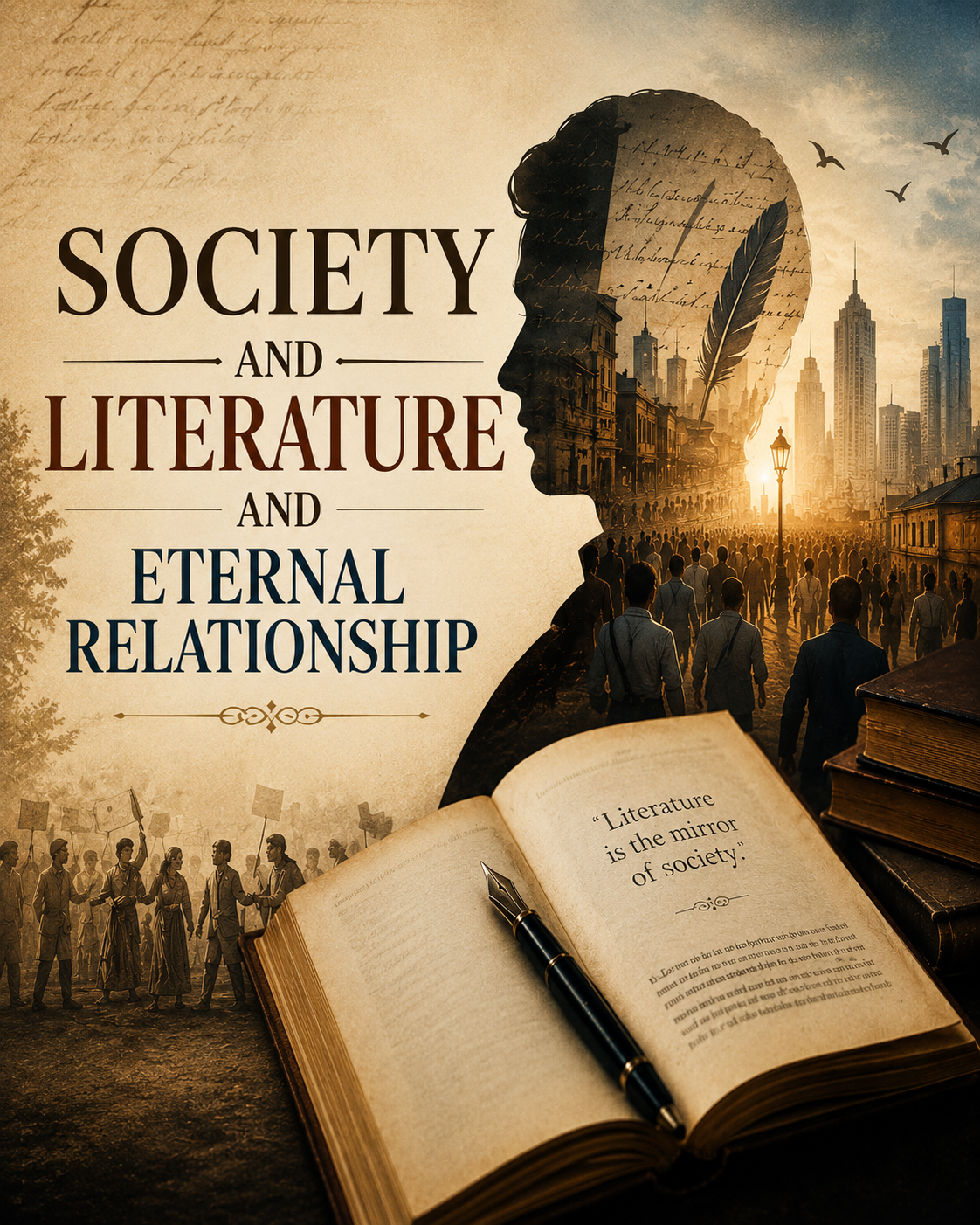

Literature and Society - An Eternal Relationship
Literature and society share very deep and interconnected relations. Society shapes literature through its politics, culture, tradition, and conflicts, but at the same time literature gives direction to the future of that society through new ideas, values, and emotions. Literature is not merely an entertainment thing but a strong social force.
The situation of a society gives birth to the literature of that society. The political, economical, social, and cultural structure of a society decides the nature of literature of that society. For instance, Premchand’s Godan is not merely the story of the character Hori but it is the situation of the millions of poor farmers of rural India in the first half of the 20th century. Literature captures the situation of society far better than the factual history textbooks because literature preserves the emotions of the masses. For example, Saadat Hasan Manto’s partition literature is far better and heart-touching than any government’s factual records buried in the big dark archives. Thus, literature is a reflection of society.
This does not mean that literature is only the reflection of society and it doesn’t have anything of its own. The truth is that literature gives society new ideas, new ways to solve its problems, and values. For example, the Bhakti movement in South India in the 7th-8th century gave transforming literature to society which fought against casteism and priestly monopoly on religion. Even in North India, the revolutionary poets like Kabir gave a positive direction to society and fought against social evils. I can quote many such poets and writers — like Tulsidas’s Ramcharitmanas, which gave Indian society a new aspiration through the concept of Ram Rajya.
Literature provides a voice to society; it empowers the common man to speak against injustice. The writers of a society write on behalf of the oppressed. Sarfaroshi Ki Tamanna by Bismil gave motivation to a depressed Indian society to fight against the injustice of the British. One can also look at Ramdhari Singh Dinkar and Suryakant Tripathi Nirala, who wrote modern literature that gave Indian society a flame of revolution.
Another major contribution of literature is the development of empathy and critical thinking in society. Reading literature makes people understand things better on their own.
A society cannot survive only on economical and technological growth, as we humans are emotional beings, and literature expresses the moral and emotional feelings of our society.
Literature and society share an unbreakable relation and both of them complement each other.