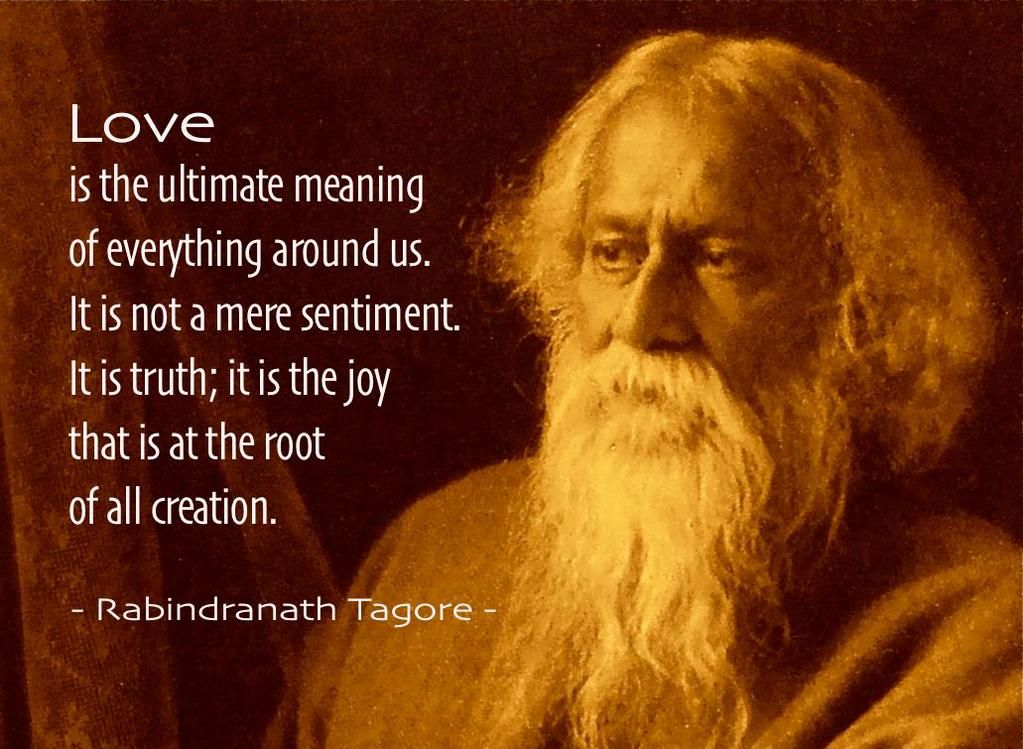

"You cannot cross the sea merely by standing and staring at the water." The famous quote which means that we should not let ourselves involve in vain wishes has been penned by the Nobel laureate, Rabindranath Tagore who was recognized, according to the Nobel committee's statement, "because of his profoundly sensitive, artistic and heart-touching verse, by which, with consummate skill, he has made his poetic thought, expressed in his own English words, a part of the literature of the West".
Very famous Rabindranath Tagore born on 7th May 1861 in Calcutta was the son of Debendranath Tagore, a leader of the Brahmo Samaj ,which was an emerging religious sect in nineteenth-century Bengal and which attempted a revival of the ultimate monistic basis of Hinduism as laid down in the Upanishads. He studied at home till seventeen and then he was sent to England for formal schooling and later.
His main concern relied upon the thread to the freedom of downtrodden peoples across Asia. Hence, Tagore was able to “be like the Centre” or “to be like us”, demonstrating that he had an open mind to understand and to explain the complicated reality of Asia at the first half of past century. He has been into an experimental school at Shantiniketan where he tried his Upanishadic ideals of education. He consistently participated in the Indian nationalist movement, though in his own non-sentimental and visionary way having Gandhi as his devoted friend. Tagore was knighted by the ruling British Government in 1915, but after few years he resigned the honor as a protestor against British rules in India.
He had earned success as a writer in his native Bengal. With his ecstatic translations of some of his poems he became rapidly known in the West. In fact his fame attained a luminous height, taking him across continents on lecture tours and tours of friendship. For the world he became the voice of India’s spiritual heritage; and for India, especially for Bengal, he became a great living institution.
Among his fifty and odd volumes of poetry are Manasi (1890) [The Ideal One], Sonar Tari (1894) [The Golden Boat], Gitanjali (1910) [Song Offerings], Gitimalya (1914) [Wreath of Songs], and Balaka (1916) [The Flight of Cranes]. The English renderings of his poetry, which include The Gardener (1913), Fruit-Gathering (1916), and The Fugitive (1921),that do not generally correspond to particular volumes in the original Bengali; and in spite of its title, Gitanjali: Song Offerings (1912), the most proclaimed of them, contains poems from other works besides its namesake.
His renowned plays are Raja (1910) [The King of the Dark Chamber], Dakghar (1912) [The Post Office], Achalayatan (1912) [The Immovable], Muktadhara (1922) [The Waterfall], and Raktakaravi (1926) [Red Oleanders]. He is the author of several volumes of short stories and a number of novels, among them Gora (1910), Ghare-Baire (1916) [The Home and the World], and Yogayog (1929) [Crosscurrents],etc.
1.Gitanjali : Being an anthology of poetry and most renowned and influential work by Rabindranath Tagore. Published originally in 1910, Tagore rereleased it as a series of translated prose poems in English, titled ‘Gitanjali: Song Offerings’, and came out in the printed form in the year 1912. W.B. Yeats authored the introduction of the English version. Tagore was inspired by the Indian lyrics of devotion from medieval times and emphasised on ‘Love’ is the principal subject of Gitanjali. Amongst the most famous books by Rabindranath Tagore, this series was internationally lauded for its musical and rhythmic poetry and led Tagore to win the Nobel Prize in Literature in 1913.
“When I sing to make you dance I truly now why there is music in leaves, and why waves send their chorus of voices to the heart of the listening earth—when I sing to make you dance.“
2.The Postmaster : It's greatest romantic as the story beautifully explores human condition its varied forms, from the innocence of childhood to the contrast between a bustling city and a rustic village as well as love and loss and the natural and supernatural.
3.Chokher Bali : Often referred to as the first modern Indian novel, Chokher Bali tells the story of a beautiful and educated widow Binodini in a society that believed in isolating widows from the community and leaving them for a life filled with despair and nothingness. As a well-read woman, Binodini is aware of this negligence prevalent towards widows in her society and as the novel progresses, Tagore intricately builds a complicated web of relationships which begins with Binodini’s jealousy towards Mahim and Asha’s marital bliss .
“As a flower plucked from a tree gradually droops and shrivels, love that avoids the harsh realities of practical life cannot thrive on its own resources.”
4.Waiting : Tagore talks about recognizing the divine within oneself. Tagore was a man who was deeply inspired by Hindu philosophy, especially the Upanishads. He refers to the Hindu belief that God resides as the soul in each being. Therefore devotion or spirituality, according to him, is a deeply personal journey. He tries to make the reader understand that devotion is progression till we reckon with our innermost self. Tagore says that although he as a seeker is progressing towards unison with god, he says it cannot happen as his own journey towards enlightenment is still developing.
“The song I came to sing
remains unsung to this day.
I have spent my days in stringing
and in unstringing my instrument.”
5.On the Nature of Love : The objective of this poem is physical search for a life partner or a companion whom we love the most. The poem rests on the idea that our life partner is predestined and therefore the poet is seen to be searching for his soul mate now and then. In this poem, the search through the forest is the search for true love and the lightning represents destiny, which according to the poem is the end of the final search.The driving force for pursuing the search is that it would bring eternal happiness and satisfaction in true sense on its successful completion.
“The night is black and the forest has no end;
a million people thread it in a million ways.
We have trysts to keep in the darkness, but where
or with whom – of that we are unaware.”
Besides these, he had written musical dramas, dance dramas, essays of all types, travel diaries, and two autobiographies. Tagore also left numerous drawings and paintings, and songs for which he wrote the music himself. Unfortunately, Rabindranath Tagore died on August 7, 1941.It's keenly been observed that Rabindranath Tagore's writings are deeply rooted in both Indian and Western learning traditions. Along with fictious poetry, songs, stories, and dramas, it also includes portrayals of common people's lives, literary criticism, philosophy, and social issues.
Rabindranath Tagore originally wrote in Bengali, but later reached a broad audience in the West after recasting and recreating his works in English. In contrast to his hysterical life spent in the West, his poetry was felt to convey the peace of souls in harmony in the nature and beyond.