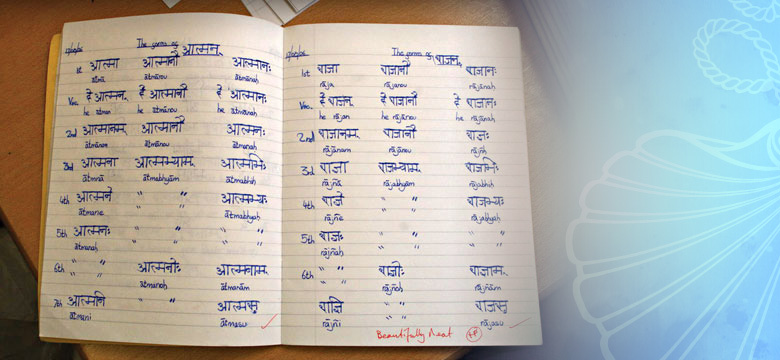


It would be wrong to differentiate Sanskrit from English, because numerous words in English have come through the Sanskrit language. If you explore the etymology of English words, you will eventually find that Sanskrit goes through every nook and cranny of the English language.
It is true that written English obviously looks different, but nevertheless the essential part of any language is not the words but what these words stand for: the meaning. It is difficult to describe how meaning is passed through these words which I am speaking to you now and you understand. But that’s where our unity, Advaita, takes place.
I am talking of this present age in which the Sanskrit language has been given a place of respect in the West. You can communicate nearly anywhere if you know English language – not otherwise. Britain is the home of English language. It holds the possibility of speaking to the world. You can’t speak to the world with the Sanskrit language. You have to learn English, the only language in the world today which we can communicate anywhere in depth. So we ought to appreciate the hard work, the tremendous work, done by those who created English language. It has bought together almost the whole world, except, say, China and Russia.
Those who know English language can understand Sanskrit language. So we are very fortunate. Somehow it happened that Sanskrit language came to the West, and the West is spreading it everywhere. How much we are going to understand and absorb it will be seen in the next generation. How much we pass on to the new generation is our job. We can’t say definitely how things are going to take shape, because apart from much good work on Sanskrit language there are other forces all over the world which are trying to influence the future of the world.
So it is necessary for all of us to examine why Sanskrit is valuable. If you do not carefully examine the language yourself then Sanskrit will become a passing phase. It will progress, leaving you in a mild state of appreciation, but not going into the depth of the language. So it is necessary for us to be very sincere in learning the language, and the essential part of learning is analysing.
Every human being has the capacity to analyse an idea, because intelligence is part of our nature. We are born with it, and it is quite possible to develop what we receive, and this creativity is very necessary for us to use. I am sure you must have found some relationship of Sanskrit with English, particularly in compound words and upasargas, mostly produced by Sanskrit laws when English was being evolved. It had evolved and somehow in history we came together, and it was found to be true that English is closely related to Sanskrit.
What I myself feel is that English is a child of Sanskrit language. It may or may not be true, but this is how I feel, this is how I see; not just by imaginative process, but in reality. The more you study Sanskrit the more you go deeper into English. That’s why we need to respect Sanskrit language and try to understand the laws which it has in its making. Sanskrit language is an extremely lawful language. My request is to give it a little more space in your mind and heart.
An edited excerpt from a lecture given in London on Sanskrit
S.M. Jaiswal (1923 to 2013)