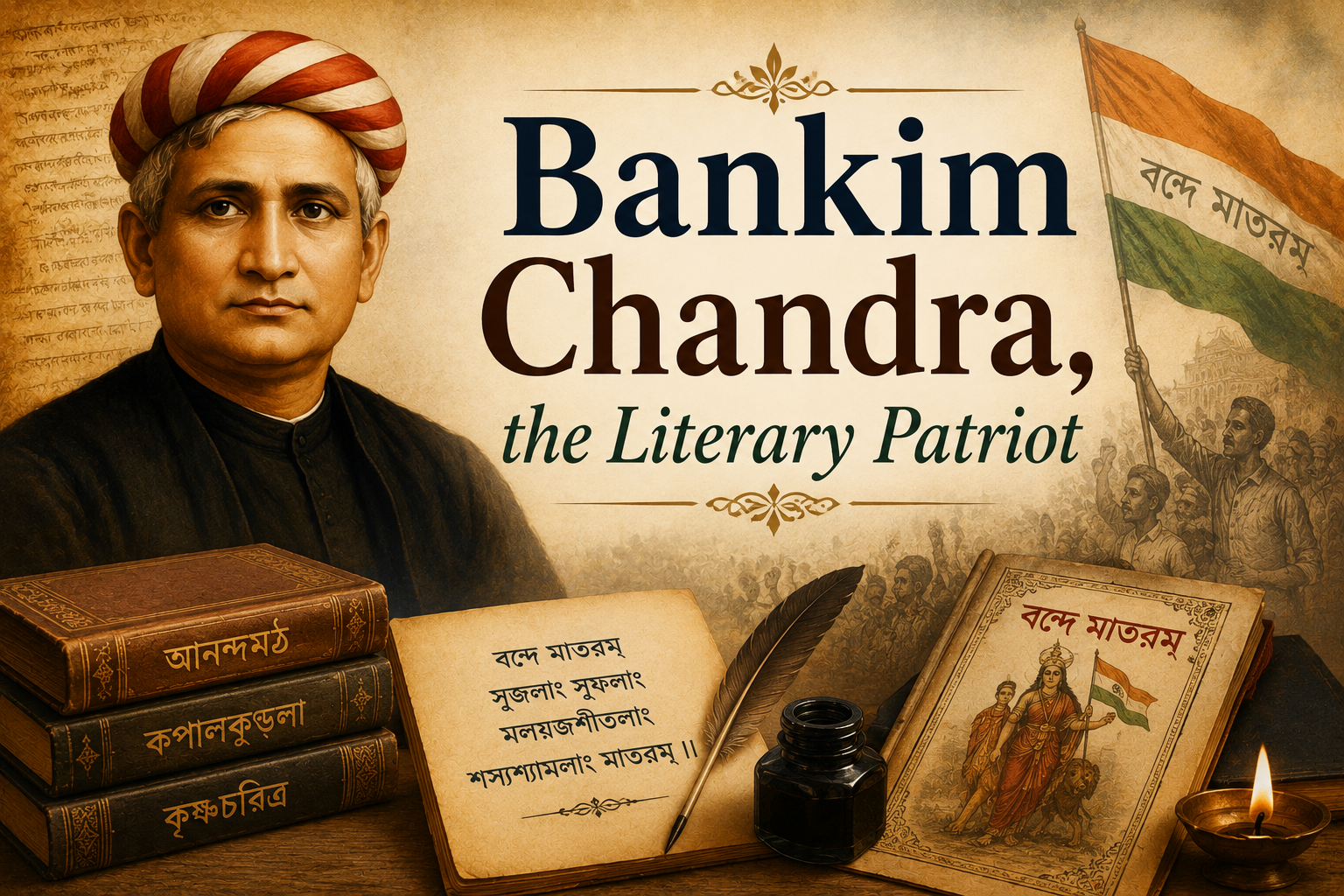

Bankim Chandra, the Literary Patriot
Bankim Chandra Chattopadhyay had played a magnificent role in shaping the cultural and intellectual identity of modern India. A novelist, poet, essayist, and civil servant, he was much more than a literary figure. He is remembered as a great thinker of the freedom struggle who inspired generations of the nation.
Bankim Chandra Chattopadhyay was born in Bengal in 1838. He completed his education from Presidency College in Kolkata. In 1858, he became one of the first graduates of Calcutta University, earning a bachelor's degree. Later, he also obtained a law degree from the same university in 1869. After completing his education, he became an ICS officer in the British Indian government and worked as a deputy magistrate. Although he had a successful government career, his true passion was writing. He believed that literature had the power to educate people, inspire them, and strengthen their connection with their own heritage.
He played a vital role in developing Bengali literature. He is an expert in expressing emotions through words. His literature not only enriched Bengali literature but also inspired the Indian freedom struggle and Indian nationalism.
One of the most popular works of Bankim is Anandamath, which occupies a special place in Indian history. In this book, he introduced the famous Vande Mataram, which, after independence, became the national song of the nation. Through his words, Bankim inspired Indian people to take pride in their culture and gave them confidence in themselves, which helped us in the freedom struggle.
He also wrote many other exceptional works of Indian literature. Durgeshnandini, Kapalkundala, Mrinalini, Vishabriksha, and Rajsimha, etc., are some popular names of his works. Also, his works hold a charismatic quality, which came because of the powerful and impressive writing ability of Bankim Chandra Chattopadhyay.
As an individual, Chattopadhyay was very intelligent, thoughtful, and deeply interested in philosophy and spirituality. In the later half of his life, he wrote many essays on ethics, morality, and religion. He believed that literature is not about entertaining people but about guiding people and contributing towards the progress of the nation and society.
Bankim Chandra passed away in 1894, but his influence continues to be felt even today. His novels are still read and admired, and Vande Mataram remains a symbol of patriotism for millions of Indians. His life reminds us that a writer's words can inspire generations, preserve cultural traditions, and help shape the future of a nation.