

[Stories and Poetry from the Room of IAS Officers]
By this moonlit night,
as you hold my hand
and sprinkle over me with your soft words,
your love rekindles my heart
and I feel sublime
(“Ageless Time & We”)
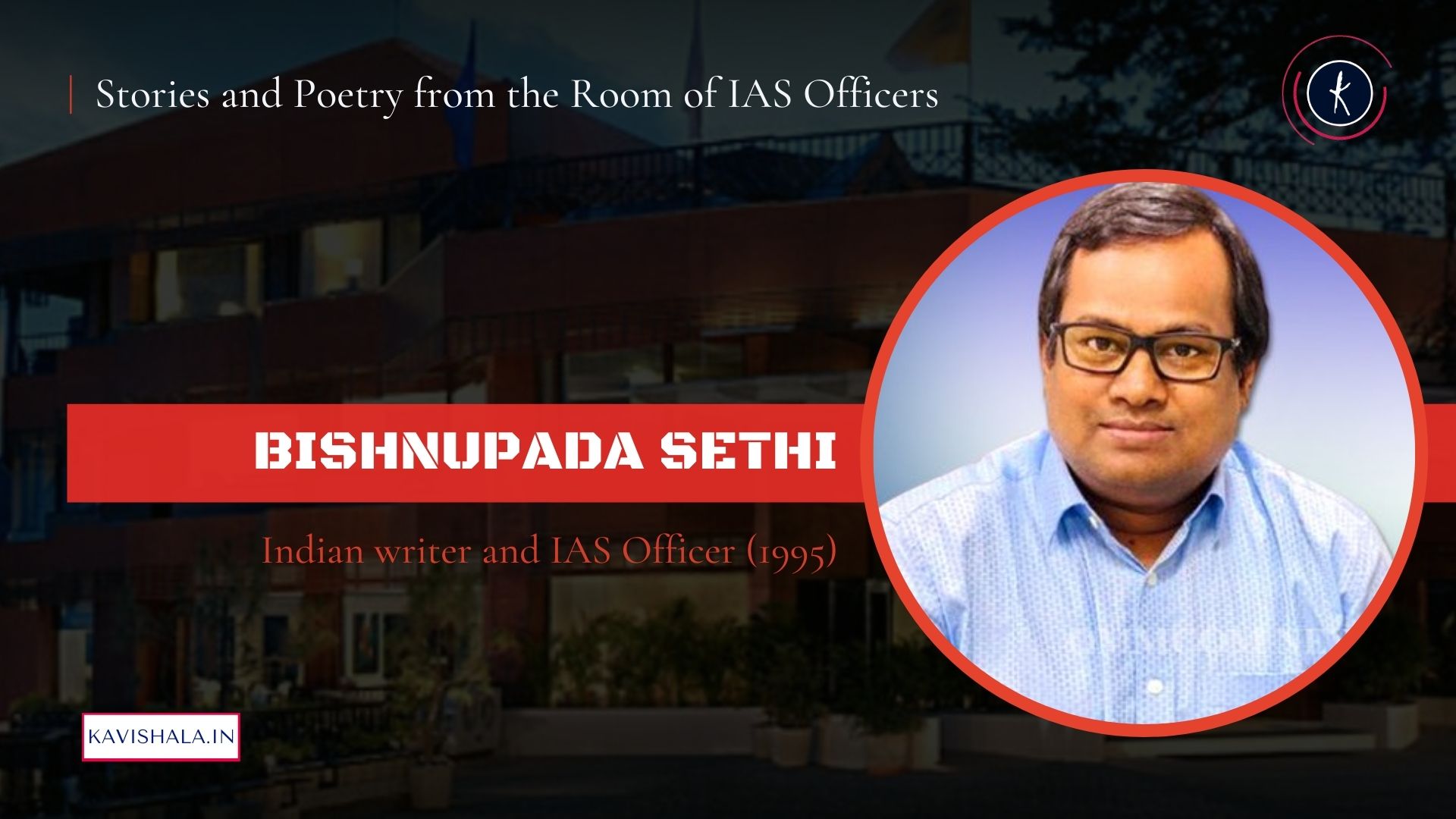
Bishnupada Sethi: Received his professional education from the National Institute of Technology, Rourkela in the branch of Mechanical Engineering and then master's degree in Industrial Engineering from the National Institute of Industrial Engineering, Mumbai, India. He joined the Indian Administrative Service and worked in different posts. He also worked for the United Nations Development Programme. Presently, he is posted as the Principal Secretary, Revenue & DM Department/ Odia Language, Literature & Culture Dept., Govt. of Odisha.
[Ashes Charcoal And Identities - Bishnupada Sethi]
There is more chill
In the air than usual.
The night appeared heavier.
Though thenearby landmass was duty bound
To cool the heated sea
But the rule here is broken.
The gush of sea breeze
Blows over the heaps of blazing wooden logs.
The sands have darkened, where
I searched for the dreams of my ancestors
Within those tiny fine charcoals
And the moisture in the air.
We carried here last of his things
Including the body he was covered with.
Nothing will be taken back from here
Except few confusing beliefs and fond memories.
I looked back
For the last time
As I prepared to leave.
The sky above,
The thundering sea,
The forgetful mortal beings
Hardly gave any convincing reason
To believe-
If I am anything or
What I claim myself to be.
Few more wailing people join
Crowding the place.
The focus of attention changes place.
No one asks and remembers-
Who came,
Who went away.
The identity is reduced to few
Mere ashes,
Few charcoal
Without the names-
All lie scattered.
[He Exists - Bishnupada Sethi]
I was feeling hurt
Bullied, desolate and bereft-
Sobbingly, I looked out
For those firm hands,
A masterly voice
And for drawing solace.
Travelling bare feet
Withstanding hot sand and Sun
Before I could give up
He would lift me on his shoulder,
The mightiest and strongest of the men-
I would've nothing to fear.
Many of the storms I weathered
Hardly left a scratch mark-
I saw the nature's fury
Ravishing everything
Ruining man's pride,
Yet I had sound sleep
No worry in the mind.
I don't remember any great pain I'd
Of hunger, thirst or fever.
The stout hands cared-
The love was unconditional
Enveloping my world.
Decades later, now
Upon hearing something unpleasant
Or at irregular times
I would hear the same voice feeble though-
"There's nothing to worry my son
For there's God
He has His hands upon you
Like I held your hands once
And He knows His job well.
Never to feel low
Or let down
Have your faith on Him
Trust me He exists
Nothing could be there
Without His wish."
[Here Is A Message - Bishnupada Sethi]
There is certain silence in the air
Broken by the incessant rain drops
On the roof tops and the tree branches.
The coolness wafted by the breeze
Doesn't rupture the silence in the hall.
The music of rain goes on
In perfect rhymes and volume.
The voices here have gone mute.
The focus of attention drifts
From the music of nature around
To the celebrations and events
Of the past.
Why do untimely events take place?
Why did the dark clouds descend
When the Sun blazed
The day being at the peak of brightness?
Here is a message
Deep down from the fresh memory-
You are in your deep slumber.
Everything remains as it was before.
Believe in the past being real
As much as you trust your present.
He was there.
He is there.
Don't trust so much the current turn of events
To disbelieve in the past.
In this realm
The past, present and future coalesce
And the time is not linear.
You can move from your place to anywhere.
You could be there
Anywhere and everywhere.
Books:
- Beyond Feelings: Bishnupada Sethis third volume Beyond Feelings carries forward the search with which he began his poetic journey in his first volume Where Shall I Go! Here questions of home and destiny keep eluding the poet as he realizes that both of them ever keep changing their places or merging one with the other. Finding that he has no desire to move away from (home) he carries it in him wherever he goes. And the idea of home for the poet is not a definite place where he lives but the places and situations where he has been. The pillars of strength of Sethis poetry are fulfilling filial relationship, childhood innocence and participation in cultural activities. Yet it is the scientist in him that brings about a just equilibrium; Like the particles in air/and clay in waters/ in my mind, the heavier matters/ are all settling down. Fine residues they are. Once conflicting matters settle down to the bottom of ones understanding one does not have to grope for, as Sethi shows, answers to the ever bugging questions like Where was I? or Where am I heading? Above all, the poets distancing from the objects of desire has enabled him to achieve a lucidity which becomes the watermark of his poetry. The volume could not have been titled better.
- WHERE SHALL I GO! : Where Shall I Go!- This is a question arising in the mind of a simple tribal person as he is asked to move out to provide physical space for setting up of industry and ushering in modernization. The sanctity attached to the surroundings of his living space, where his ancestors also live there, is not understood by the modern man: to say the least about appreciating the same. Several questions are redirected to the inner side of his mind, the questions rebound, resonate without answers. There is a great need to develop respect and love for all, so that we exist. The reality about the world is the living experiences, which remain inside one’s mind. As tradition changes with the times, many of us face many challenges. Some cope up without answers to the inner queries; some others can not. These poems have been written over a period of about ten years. The poet has traveled with the time and over spaces. These poems are about certain feelings about the objects and activities of the material world. There have been extrapolations beyond certain limits of mind, when the questions have not yielded easy answers. The extrapolations have been as a result of natural process of living and experiencing.
- The poems are about nature, love and relationships. There is a great deal of happiness and love in living this life on this earth. The journey of life is beautiful. One must live a life that naturally comes to him; and he must have the freedom to live one such life. The mind seeks expanding frontiers of freedom, to think, to feel, to experience, to feel free.
- Demographic Profile of Odisha (First Edition 2016): This Book contains Statistics and Demographic Profile of Odisha and is written by IAS officer Mr Bishnu Charan Sethi while he was the Director of Census, Odisha State, a very useful Book for Researcher, Reference material for Library Books and those who are in need of vital statistics about Odisha
- The Scheduled Tribes in Odisha A demographic Analysis (Demographic Analysis): Peasantry all over the world is the subaltern group who are most deprived, exploited ; but their fierce resistance brought many structural changes both in modes and relations of productions. All the peasant movements in the context of odisha just after independence were rooted in the warmth of the pre independence mushrooming. The movement against the abolition of zamindari system was much more serious and touched almost all districts of the state. These pressure from the down compelled the government to pass Zamindary Abolition Act in 1951.Peasant movements sere wide spread all over the state but share croppers movements were more concentrated in coastal districts and western Odisha . As a result of which OLR Act was passed in 1961.
- THE WAY WITH THE WORD: In one perhaps finest ever analysis of Philip Larkin’s poem, “Arundel Tomb”, Christopher Ricks showed two equally plausible ways for the readers to take when he said that if we lay stress on the word “survive” the poem is classical but if we hinge upon the other potent word “love” the poem is romantic. These two words occur in the last line of the poem, and that classic line is “What will survive of us is love”. Here in the case of Bishnupada Sethi’s collection My World of Words under review the thrust is, as against his first book Where Shall I Go?, on the romantic:
By this moonlit night,
as you hold my hand
and sprinkle over me with your soft words,
your love rekindles my heart
and I feel sublime
(“Ageless Time & We”)
This poem, thus, beginning in an endearing way moves from the romantic to the sublime. This movement, sometimes linear, sometimes cyclic, is a conspicuous presence in most of the poems included in this volume. Sethi’s search for love, in a way for fulfillment, is encompassed in the time-tested, eternal value which is handed down to us through generations, and the most powerful element with which the universe is made up of is nothing but love: “the universe is made out of love”(“Beyond Love”). In the cosmos of love all “the sad memories” are erased and in moments like this when one feels uplifted the poet says, “I will forget/ all the un-savoury words/spoken about me.” This virtue of forgiveness comes from the realization that he “won’t be there for all the time to come”, as the poet would say in the striking poem “Time is Short”.
If in “Time is Short” the poet is ready to forgive in “Please Forget Me” he seeks forgiveness, that points to the sublimation of the poet’s self. This is a goal which Sethi has set for himself in poem after poem. This journey of the self from the material to the spiritual is facilitated by the poet’s effort at minimalising his self and need. And this sublime feeling is nowhere better evinced than in his expression “less than a shadow/ I have dried up in the heart’s nature’s law.” Yet what will sustain him is memories which are
Arousing innocent desires
and burning them inside
(“Memories”)
“Arousing” and “burning” are two key words in getting at the pulse of Sethi’s poetry. It is better to have desires and get them doused than not to have them at all. This way, it makes one complete. Sethi does it well.
Finally, as for the art of Sethi’s poetry, most of his poems are addressed to “you”. This “you” helps the poet in defining his stand, the nature of his relationship with the other. That in relationship one could err cannot be ruled out, and that the poet with all his words has at his disposal to create a new order has also feet of clay. Sethi reminds us of it precisely when he says
I hold no view
if my body is sacred
I use my body
(“Survival”)
Again, thematically, poetry as practiced by Sethi is a question of “survival” for those who are meek, who are voiceless; poetry gives voice to the silent one: “The known words rearrange/ as I gather experience anew./Another story is added.”. With the story of the mankind at hand, Sethi is able as much to get along as to say “goodbye”. - Rabindra K Swain