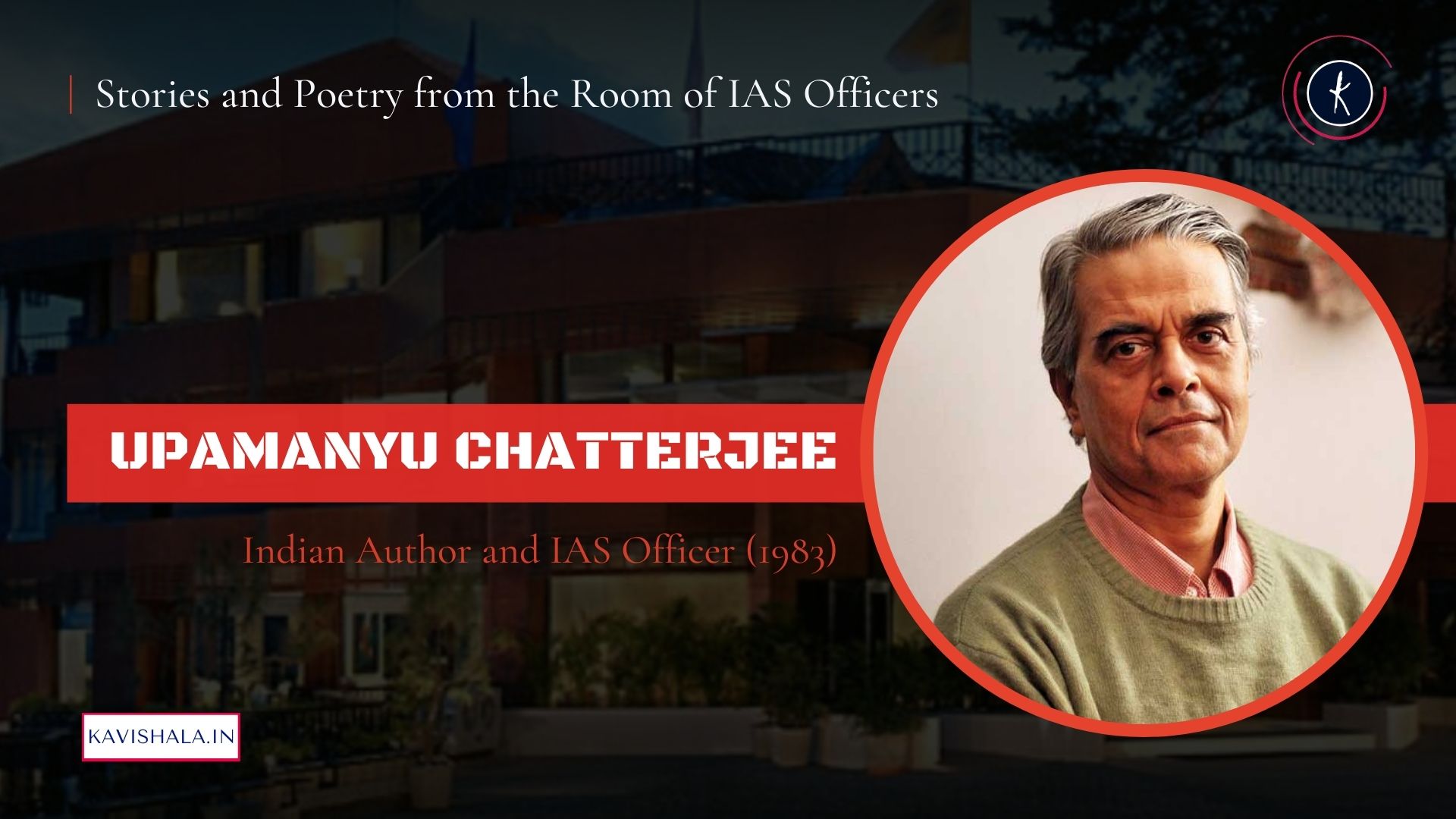

[Stories and Poetry from the Room of IAS Officers]
Upamanyu Chatterjee is an Indian author and administrator, noted for his works set in the Indian Administrative Service. He has been named Officier des Arts et des Lettres (Officer of the Order of Arts and Letters), by the French Government.
Upamanyu Chatterjee (born 1959) is a retired Indian civil servant who served as Joint Secretary to Government of India on the Petroleum and Natural Gas Regulatory Board. He is a 1983 batch Indian Administrative Service officer from Maharashtra Cadre. He currently resides in Sri Lanka.
He is an author best known for the novel English, August.
Chatterjee has written a handful of short stories. His best-selling novel, English, August : An Indian story (subsequently made into a major film), was published in 1988 and has since been reprinted several times. The novel follows Agastya Sen – a young westernised Indian civil servant whose imagination is dominated by women, literature, and soft drugs. This vivid account of "real India" by the young officer posted to the small provincial town of Madna is "a funny, wryly observed account of Agastya Sen's year in the sticks", as described by a reviewer in The Observer. His second novel, The Last Burden, appeared in 1993. The Mammaries of the Welfare State was published at the end of 2000 as a sequel to English, August. His fourth novel, Weight Loss, a dark comedy, was published in 2006. His fifth was Way To Go, a sequel to The Last Burden, published in 2010. His most recent work is Fairy Tales at Fifty, was published in 2014. Dr. Mukul Dikshit opines that Chatterjee has, for the first time, focused on a "new class" of Westernised urban Indians who were hitherto ignored in the regional as well as the English fiction of India.
In 2009, he was awarded Officier de l'Ordre des Arts et des Lettres in recognition of his "exemplary contribution to contemporary literature" In 2004, he was awarded the Sahitya Akademi Award for The Mammaries of the Welfare State. The novel Way To Go was shortlisted for The Hindu Best Fiction Award in 2010.
Some snippets/ quotes from the Book:
- “Only when you die will you cease to feel ridiculous.”
- “We are men without ambition, and all we want is to be left alone, in peace so that we can try and be happy. So few people will understand this simplicity.”
- “In his essay,Agastya had said that his real ambition was to be a domesticated male stray dog because they lived the best life.They were assured of food,and because they were stray they didn't have to guard a house or beg or shake paws or fetch trifles or be clean or anything similarly meaningless to earn their food.They were servile and sycophantic when hungry;once fed,and before sleep,they wagged their tails perfunctorily whenever their hosts passes,as an investment for future meals.A stray dog was free,he slept a lot,barked unexpectedly and only when he wanted to,and got a lot of sex.”
- “No one reveals himself more completely to others than to himself - that is, if he reveals himself at all.”
- “I'm happy for you Agastya,you're leaving for a more meaningful context. This place is like a parody, a complete farce, they're trying to build another Cambridge here. At my old University I used to teach Macbeth to my MA English classes in Hindi.English in India is burlesque. But now you'll get out of here to somehow a more real situation. In my time I'd wanted to give this Civil Service exam too, I should have. Now I spend my time writing papers for obscure journals on L. H. Myers and Wyndham Lewis, and teaching Conrad to a bunch of half-wits.”
- “He absent-mindedly fondled his crotch and then whipped his hand away.No masturbation,he suddenly decided.He tried to think about this but sustained logical thought on one topic was difficult and unnecessary.No,i am not wasting any semen on Madna.It was an impulse,but he felt that he should record it.In the diary under that date,he wrote,'From today no masturbation.Test your will,you bastard'. Then he wondered at his bravado.No masturbation at all?That was impossible.”
- “You feel even more naked and alone, he said silently, when you reveal yourself, a gratuitous act, for the strength and comfort you look for, any of those last illusions of consolations, can finally be only within you.”
- “Land is important everywhere, all kinds of land. But you have lived in cities. There you cannot sense the importance of agricultural land, it's the real wealth. Each of these squares and hexagrams could be worth lakhs.”
- “He didn't want the friends of the different stages of his life to meet. Their encounter would almost be between different facets of himself, face to face.”
- “God is a first-rate bureaucrat, one of the best. In all matters, He sees the truth, but is yet to take a decision.”
- “It was soporific to be mindlessly shunted about in a vehicle, to succumb to marijuana, the heat, the rhythm and roar of the jeep”
- “Yet one more encounter with new faces, he thought, as he watched a tree and a cloud move past in slow motion, and eventually this one would also blur into the others; all that would remain distinct, perhaps, would be a few words that only he would deem significant, or an angle of a face, which in turn his mind would link with other things, some oddity of accent, or some other words confusing time and place and people to look for a pattern, some essence.”
- “Far away in a field was a farmer behind two oxen, ploughing, three slow spots in a landscape of brown and green. Agastya looked at him and thought, too many worlds, concentric, and he a restless centre.”
- “The Gita reminded him of the joker of Madna. "If thou wilt not fight thy battle battle of life because in selfishness thou art afraid of the battle, thy resolution is in vain: nature will compel thee. Because thou art in the bondage of Karma, of the forces of thine own past life.”
“It was soporific to be mindlessly shunted about in a vehicle, to succumb to marijuana, the heat, the rhythm and roar of the jeep”
Books:
- English, August : An Indian story: Agastya Sen, known to friends by the English name August, is a child of the Indian elite. His friends go to Yale and Harvard. August himself has just landed a prize government job. The job takes him to Madna, “the hottest town in India,” deep in the sticks. There he finds himself surrounded by incompetents and cranks, time wasters, bureaucrats, and crazies. What to do? Get stoned, shirk work, collapse in the heat, stare at the ceiling. Dealing with the locals turns out to be a lot easier for August than living with himself. English, August is a comic masterpiece from contemporary India. Like A Confederacy of Dunces and The Catcher in the Rye, it is both an inspired and hilarious satire and a timeless story of self-discovery.
- The Last Burden: A fascinating portrayal of life in an Indian middle-class family by the best-selling author of English, August Upamanyu Chatterjee's second novel brilliantly recreates life in an average Indian family at the end of the twentieth century. Jamun, the central character, is a young man, unmarried, adrift. He stays away from his family, which comprises his parents, Urmila and Shyamanand, his elder brother, Burfi, his sister-in-law, Joyce, his two nephews and the children's ayah. Jamun returns to the family when his mother is hospitalized. Once there, he decides to stay on until one of his ailing parent dies. He barely admits to himself that there is another, probably stronger, reason for his extended stay in the family home— an old friend Kasturi, now married and pregnant, who has returned to the city (that she associates with Jamun) . . . Flitting back and forth in time and space, and writing in a language of unsurpassed richness and power, Upamanyu Chatterjee presents a funny, bitterly accurate and vivid portrait of the awesome burden of family ties.
- The Mammaries of the Welfare State: In this sequel to Upamanyu Chatterjee's debut novel, English, August, Agastya Sen— older, funnier, more beleaguered, almost endearing— and some of his friends are back. Comic and Kafkaesque, The Mammaries of the Welfare State is a masterwork of satire by a major writer at the height of his powers.
- Way to Go: For not having loved one’s dead father enough, could one make amends by loving one’s child more? In powerful, austere prose shot through with black humour, Upamanyu Chatterjee has produced an intensely moving examination of family ties and the redemptive power of love, however imperfect, in the midst of death and degeneration.
- Weight Loss: Innocent and unremarkable, but for his near crippling obsessions with sex and running, Bhola goes through life falling for all the wrong people. At School, he lusts indiscriminately after his teachers, both male and female, and is equally attracted to eunuchs. While in college, he has vaguely demeaning affairs with his landlady, and a vegetable vendor-cum-nurse and her husband. Later, he marries (a woman with a voice like liquid gold), fathers a daughter and suspects he is close to balance and beauty. Then his past catches up with him. Upamanyu Chatterjee's genius for black humour and the absurd has never been more compelling than in this unforgettable portrait of a lost life.