
Elizabeth Hazen is a poet, essayist, and teacher. A Maryland native, she came of age in a suburb of Washington, D.C. in the pre-internet, grunge-tinted 1990s, when women were riding the third wave of feminism and fighting the accompanying backlash. She began writing poems when she was in middle school, after a kind-hearted librarian handed her Lawrence Ferlinghetti’s A Coney Island of the Mind. She has been reading and writing poems ever since.
Hazen’s work explores issues of addiction, mental health, and sexual trauma, as well as the restorative power of love and forgiveness. Her poems have appeared in Best American Poetry, American Literary Review, Shenandoah, Southwest Review, The Threepenny Review, The Normal School, and other journals. Alan Squire Publishing released her first book, Chaos Theories, in 2016. Girls Like Us is her second collection. She lives in Baltimore with her family.
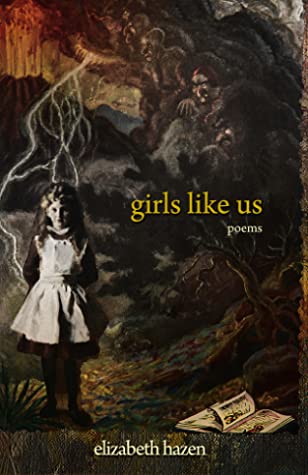
Girls Like Us is packed with fierce, eloquent, and deeply intelligent poetry focused on female identity and the contradictory personas women are expected to embody. The women in these poems sometimes fear and sometimes knowingly provoke the male gaze. At times, they try to reconcile themselves to the violence that such attentions may bring; at others, they actively defy it. Hazen’s insights into the conflict between desire and wholeness, between self and self-destruction, are harrowing and wise. The predicaments confronted in Girls Like Us are age-old and universal—but in our current era, Hazen’s work has a particular weight, power, and value.
One 'Love Poem' from the Book:
…I first believed
the tree was dead,
but months later
it blossomed, this emblem
of possibility prostrate
across our path,
this tangle of limbs
like a castaway
clawing her way back
from the sea.
What people say about her books:
Liz Hazen’s Chaos Theories is a dynamo that will alter your genetic structure and boost your intelligence. She rides into town like Athena on the horns of a Minoan bull, waving a cure for cancer in one hand and the rules of romance in the other. She harnesses the atoms and molecules of poetry like a Tesla coil, attuned to the science of our everyday lives, and leaves us sadder, wiser, and the better for it. So drink up. She’s the real deal and this is a shocking book filled to the brim with electric eels.
~ Richard Peabody, Editor, Gargoyle Magazine
When Elizabeth Hazen declares, “I want to understand our need/for headway,” it’s significant that she offers an image for progress, motion, or time, and it’s also characteristic of this poet’s “need” to ground her ideas in the body, which she tells us, “holds more mysteries/than the mouth can bring itself to speak.” And yet she does find speech for the mysteries and paradoxes of existence, speech she puts down in expertly cadenced lines that “produce the proper notes” of a restless imagination looking to find the “absent whole” in human experience.
~ Michael Collier, Director, The Bread Loaf Writers’ Conference, author of An Individual History and Dark Wild Realm
Chaos Theories, Elizabeth Hazen’s startling collection, refashions insights and principles from the hard sciences into metaphors for what it means and feels like to be alive and conscious, needy and loving, in a universe ruled by time and change. With plainspoken elegance, these poems, individually and collectively, comprise a memorable and heart wrenching evocation of the persistent and often contradictory needs that both sustain and menace the attachments that define us.
~ Alan Shapiro, author of Reel to Reel and Night of the Republic
Elizabeth Hazen’s unflinching first book Chaos Theories forms a powerful meditation on female identity and the cultural expectations that daughters, mothers, wives, and sisters resist and embrace. For Hazen, fate—familial or biological—is a form of magnificent havoc that reflects both the natural world’s lush beauty and the realities of science . . . Chaos Theories is a debut fluent in the language of desire, heartbreak, and regeneration.
~ Jane Satterfield, author of Her Familiars and Assignation at Vanishing Point
In Chaos Theories, Elizabeth Hazen explores the “instabilities”
of the human heart through the organizing impulses of poetry, which work to make sense, make order of memory, desire, and regret. This is a book of bodies and tongues but also of bright intellect, the mind scientific
here, methodical and beautiful in its efforts “to narrate, fit events to plot.”
~ Jehanne Dubrow, author of Home Front and The Arranged Marriage
Source: Elizabeth Hazen Website