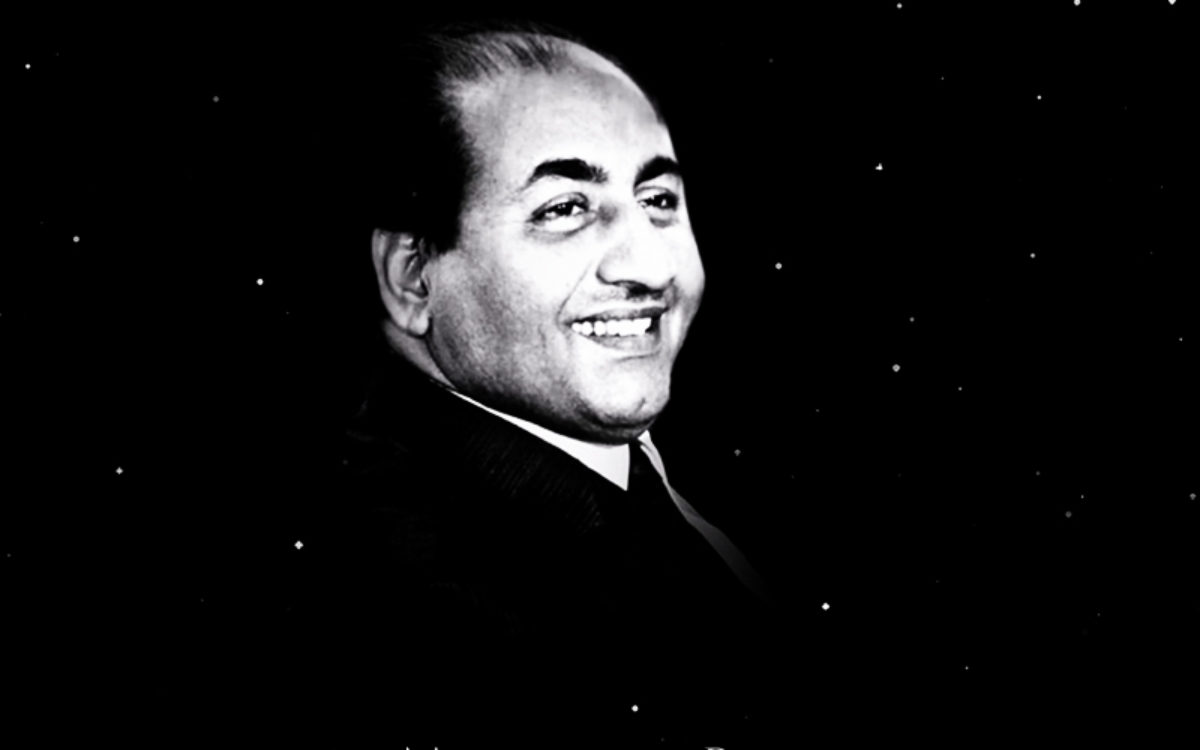
Mohammed Rafi made his Hindi film debut in Gaon Ki Gori in 1945.

[Kavishala Daily] Legendary Singer Mohammed Rafi will remain the voice of India, but his songs belong to the entire world that embraced him and to all those who are filled with hope and optimism for the future, whenever they listen to his melodies.
Tributes on his Birth anniversary.
Mohammed Rafi was the second eldest of six brothers born to Haji Ali Mohammad. The family originally belonged to Kotla Sultan Singh, a village near present-day Majitha in Amritsar district of Punjab, India. Rafi, whose nickname was Pheeko, began singing by imitating the chants of a fakir in the streets of his native village Kotla Sultan Singh where his family lived. Rafi's father moved to Lahore in 1935, where he ran a men's salon in Noor Mohalla in Bhati Gate. Rafi learnt classical music from Ustad Abdul Wahid Khan, Pandit Jiwan Lal Mattoo and Firoze Nizami. His first public performance came at the age of 13, when he sang in Lahore featuring K. L. Saigal. In 1941, Rafi, under Shyam Sundar, made his debut in Lahore as a playback singer in the duet "Soniye Nee, Heeriye Nee" with Zeenat Begum in the Punjabi film Gul Baloch (released in 1944) under music director Shyam Sunder. In that same year, Rafi was invited by All India Radio Lahore station to sing for them.
He made his Hindi film debut in Gaon Ki Gori in 1945.
He has recorded songs for over a thousand Hindi films and has sung songs in various regional Indian languages as well as foreign languages, though primarily in Hindi-Urdu and Punjabi over which he had a strong command. He has recorded as many as 7405 songs in many languages. He has sung in many regional Indian languages including Konkani, Assamese, Bhojpuri, Odia, Punjabi, Bengali, Marathi, Sindhi, Kannada, Gujarati, Tamil, Telugu, Magahi, Maithili. Apart from Indian languages, he also sang songs in many foreign languages including English, Farsi, Arabic, Sinhala, Creole and Dutch.
Guinness World Records controversy:
During his last years, Rafi was involved in a controversy over Lata Mangeshkar's entry in the Guinness Book of World Records. In a letter dated 11 June 1977 to the Guinness Book of World Records, Rafi had challenged the claim that Lata Mangeshkar has re