
In his Persian poem Chiragh-i-Dair which was composed during his trip to Benares during the spring of 1827, Ghalib mused about the land of Hindustan (India) and how Qiyamah (Doomsday) has failed to arrive, in spite of the numerous conflicts plaguing it.
Said I one night to a pristine seer
(Who knew the secrets of whirling Time)
'Sir you well perceive,
That goodness and faith,
Fidelity and love
Have all departed from this sorry land.
Father and son are at each other's throat;
Brother fights brother.
Unity and Federation are undermined.
Despite these ominous signs
Why has not Doomsday come?
Why does not the Last Trumpet sound?
Who holds the reins of the Final Catastrophe?'
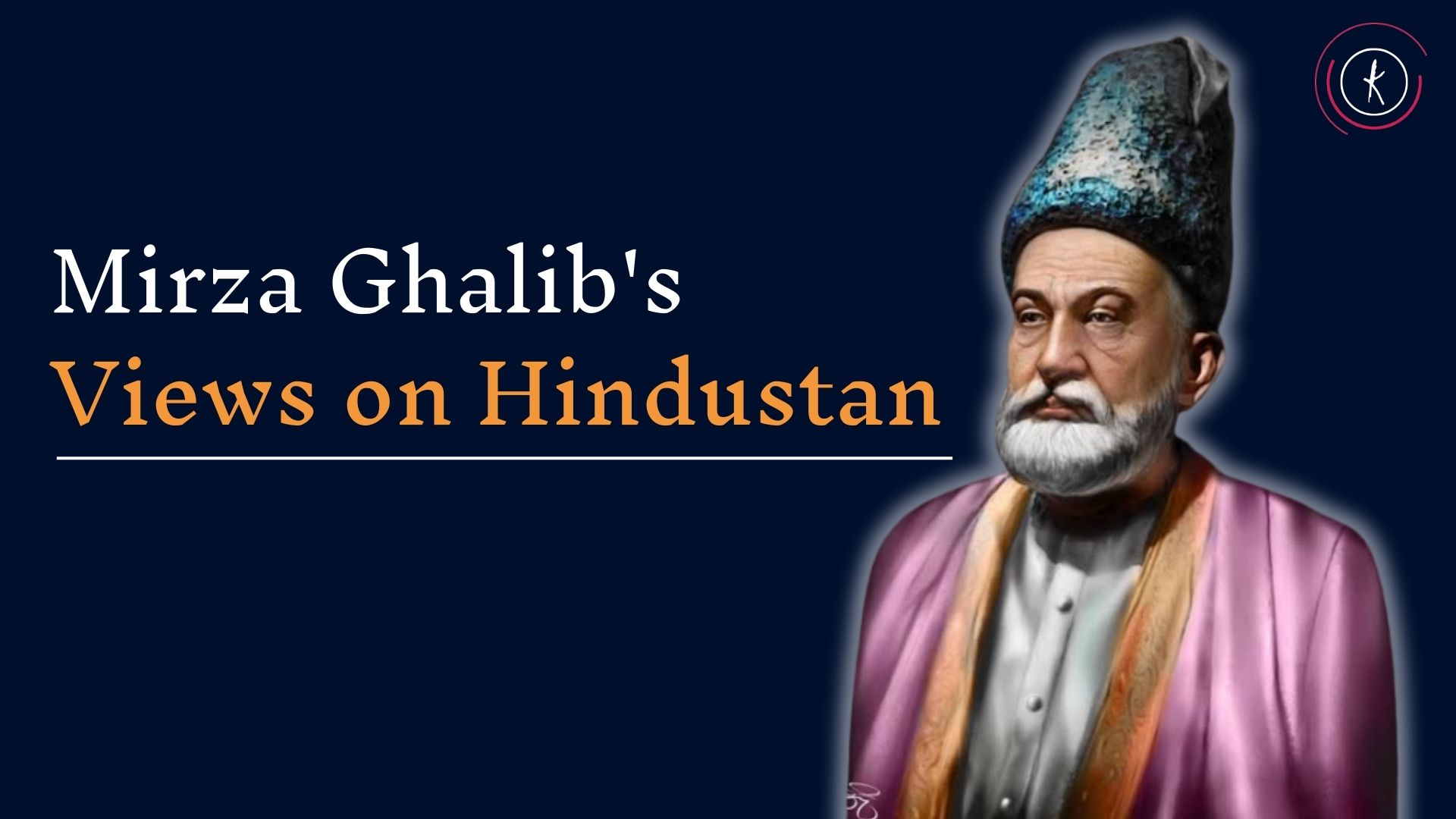
Mirza Beg Asadullah Khan (1797–1869), also known as Mirza Ghalib, was an Indian poet. He was popularly known by the pen names Ghalib and Asad. His honorific was Dabir-ul-Mulk, Najm-ud-Daula. During his lifetime, the already declining Mughal Empire was eclipsed and displaced by the British East India Company rule and finally deposed following the defeat of the Indian Rebellion of 1857; these are described through his work. He wrote in both Urdu and Persian. Although his Persian Divan (body of work) is at least five times longer than his Urdu Divan, his fame rests on his poetry in Urdu. Today, Ghalib remains popular not only in the Indian subcontinent but also among the Hindustani diaspora around the world.
According to kavishala AI:
Mirza Ghalib, the renowned Urdu and Persian poet of the Mughal Empire, expressed multifaceted views on Hindustan, reflecting the complex social, cultural, and political landscape of his time. Ghalib lived during a tumultuous period marked by the decline of the Mughal Empire and the onset of British colonial rule in India. His poetry often reflects the tensions, nostalgia, and resilience of the Indian people amidst these changes.
Love for Hindustan: Ghalib's poetry often reflects his deep love for Hindustan (India). He frequently expressed nostalgia for the glory days of Delhi, the capital of the Mughal Empire, and lamented its decline under British rule. His verses are imbued with a sense of longing for the bygone era of cultural richness and political stability.
Critique of Colonialism: Ghalib was critical of British colonialism and its impact on Indian society. He lamented the loss of autonomy and cultural decline under colonial rule. His poetry reflects a sense of resistance against foreign domination and a desire for independence.
Social Commentary: Ghalib's poetry also serves as a mirror to the society of his time. He often commented on the social injustices, inequalities, and hypocrisies prevalent in Indian society, regardless of whether they were perpetuated by native rulers or colonial administrators.
Universal Themes: While Ghalib's poetry is deeply rooted in the Indian context, it also addresses universal themes such as love, loss, longing, and the human condition. His verses resonate with people across cultures and generations, transcending geographical boundaries.
Overall, Ghalib's views on Hindustan are complex and multifaceted, reflecting the nuances of his personal experiences and the historical context in which he lived. His poetry continues to be celebrated for its timeless beauty and profound insights into the human condition.