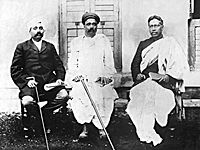
Lal - Bal - Pal: Triumvirate, Who changed the political discourse of the Indian independence movement.

Lala Lajpat Rai of Punjab, Bal Gangadhar Tilak of Maharashtra, and Bipin Chandra Pal of Bengal, the triumvirate were popularly known as Lal Bal Pal, changed the political discourse of the Indian independence movement.
Bipin Chandra Pal (7 November 1858 – 20 May 1932) was an Indian nationalist, writer, orator, social reformer and Indian independence movement activist. He was one third of the “Lal Bal Pal” triumvirate. Pal was one of the main architects of the Swadeshi movement along with Sri Aurobindo. He stood against the partition of Bengal by the colonial British government.
Pal is known as the Father of Revolutionary Thoughts in India and was one of the freedom fighters of India. Pal became a major leader of the Indian National Congress. At the Madras session of Indian National Congress held in 1887, Bipin Chandra Pal made a strong plea for repeal of the Arms Act which was discriminatory in nature. Along with Lala Lajpat Rai and Bal Gangadhar Tilak he belonged to the Lal-Bal-Pal trio that was associated with revolutionary activity. Sri Aurobindo Ghosh and Pal were recognised as the chief exponents of a new national movement revolving around the ideals of Purna Swaraj, Swadeshi, boycott and national education. His programme consisted of Swadeshi, boycott and national education. He preached and encouraged the use of Swadeshi and the boycott of foreign goods to eradicate poverty and unemployment. He wanted to remove social evils from the form and arouse the feelings of nationalism through national criticism. He had no faith in mild protests in the form of non-cooperation with the British colonialists. On that one issue, the assertive nationalist leader had nothing common with Mahatma Gandhi. During the last six years of his life, he parted company with the Congress and led a secluded life. Sri Aurobindo referred to him as one of mightiest prophets of nationalism. Bipin Chandra Pal made his e